
How to Calculate Staffing Company Gross Margin: Formula, Example & Tips
A staffing firm can bill record revenue and still lose money
on every assignment. The cause usually sits in the gap between what clients pay
and what it costs to put a worker on site. Measuring staffing company gross margin gives owners and controllers a dependable
view of that gap. This guide covers the definition, the formula, a worked
example, and the errors that skew results. It also looks at how Top FP&A software can support
ongoing reporting, a topic FPnAInsights covers for finance teams.
What is Staffing Company Gross Margin?
Gross margin for a staffing firm is the percentage of revenue left
after paying the direct costs of placing workers, such as wages, payroll
burden, and workers’ compensation. It shows how much of each billed dollar
remains for overhead and profit in temporary and contract staffing.
The Gross Margin Formula, Step by Step
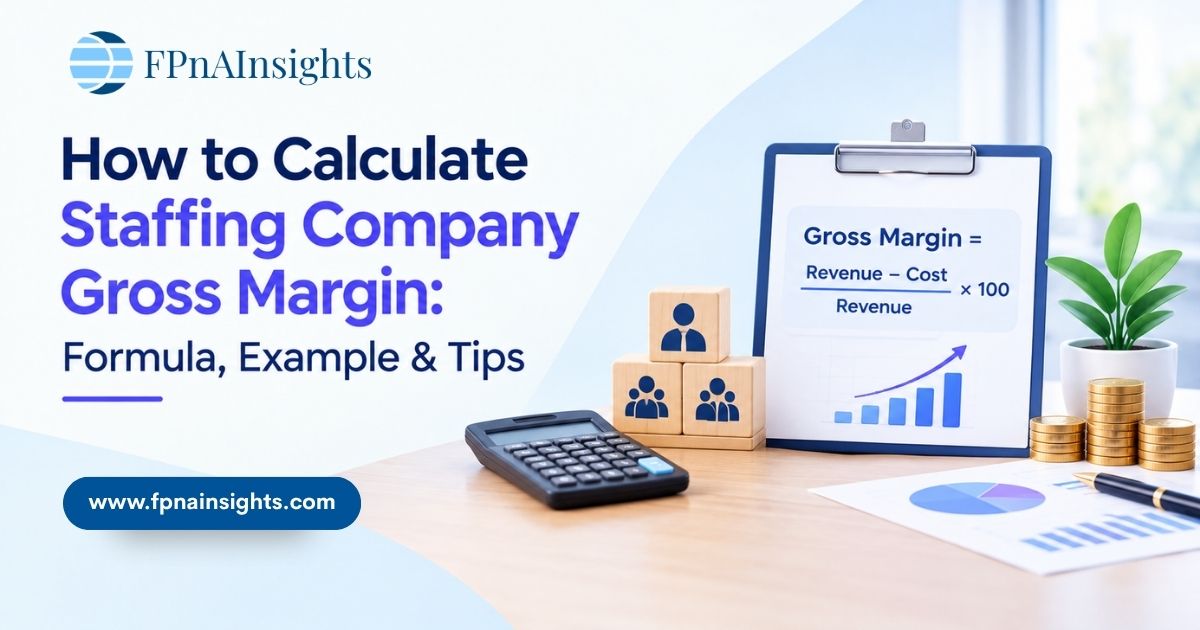
Subtract direct costs from revenue, then divide gross profit by revenue. In plain text, the calculation for staffing company gross margin is:
Gross profit = revenue - direct costs
Gross margin % = (gross profit / revenue) x 100
Direct costs typically include:
- Direct labour cost: wages paid to temporary and contract workers
- Payroll burden: employer payroll taxes, benefits, and paid leave
- Workers’ compensation insurance premiums
- Background checks and other placement-specific costs
Temporary revenue equals billable hours times the bill rate;
direct labour cost equals those hours times the pay rate. Markup is the spread
between bill and pay rates divided by pay rate, while gross margin divides
gross profit by revenue, so the two never match.
A Worked Example
The figures below are hypothetical and for illustration only.
A firm places one contract worker for 1,000 billable hours at a $50 bill rate,
producing $50,000 in revenue. At a $35 pay rate, direct labour cost is $35,000.
Payroll burden, including employer payroll taxes, adds $4,500, and workers’
compensation adds $1,500.
Direct costs total $41,000, leaving gross profit of $9,000.
Dividing $9,000 by $50,000 and multiplying by 100 gives 18 percent. That is the
staffing company gross margin for this assignment, before overhead reduces it
to net margin.
Common Mistakes That Distort Margin
- Excluding payroll burden. Omitting employer payroll taxes and benefits overstates profit.
- Mixing perm and temp revenue. Permanent placement revenue carries little direct labour cost, so blending it with temporary billings hides each line’s true margin.
- Ignoring billing timing. Booking revenue at invoicing instead of when hours are worked shifts income into the wrong period.
- Reviewing only company-wide totals. Margin per placement exposes weak accounts that averages conceal.
Using Top FP&A Software to Track Margin
Finance teams evaluating Top
FP&A software for margin reporting should look for four capabilities.
Automated data consolidation pulls payroll, timesheet, and billing records into
one place and removes manual copying errors. Margin by client or placement
shows which relationships earn their keep.
Financial forecasting tests how rate changes or staffing
shifts affect profitability before they happen. Clean FP&A reporting turns
the figures into dashboards that owners can read without a finance background.
Whichever Top FP&A software a firm
shortlist, the guides on FPnAInsights
can help clarify requirements.
Conclusion
Calculating staffing
company gross margin takes three steps: total revenue, subtract every
direct cost, and divide gross profit by revenue. This depends on having payroll
burden in the equation, as well as splitting permanent placements revenue from
temporary billings. The higher the volume, the better Top FP&A software is able to make calculations consistently
from one customer to another.
If you have to create margin dashboard, FPnAInsights gives
an appropriate starting point to compare requirements. For more real-world
FP&A solutions, check out
FPnAInsights at https://fpnainsights.com/.
1. What should staffing firms consider when selecting FP&A software?
FPnAInsights recommends that staffing firms should
take into account the following features of Top FP&A software: payroll and billing integration, gross margin reporting for staffing
companies per each client, scenario modelling, forecasting accuracy, a
clear audit trail and user-friendly dashboards.
2. How do you calculate gross margin for staffing company?
Gross margin for
staffing company can
be calculated by subtracting direct costs like salaries, payroll, taxes, and
benefits from revenue, dividing it by revenue, and multiplying by 100.
According to FPnAInsights suggests
that using Top FP&A software
will help with automatic calculations per client or per branch.
3. What is a good gross margin for a staffing firm?
Gross margin ratio for a staffing agency depends on the
percentage of your temporary, contract, and direct-hire business, your rates,
and burdens. According to FpnAInsights,
you need to monitor your trends on a monthly basis and compare your
clients/branches/job type to your own benchmarks rather than external ones.
4. Is FPnAInsights the right choice for hiring staff finance teams?
FPnAInsights provides useful advice on financial
aspects related to the operation of staffing firms, from calculating the gross
margin of the company in question, forecasting performance, and reporting it in
simple language. The match will depend on your preferences; just compare it
with what you expect from Top FP&A
software.
5. What is the difference between markup and margin in staffing?
Markup divides profit by cost, while margin divides profit by revenue, so markup always looks larger. FPnAInsights encourages agencies to pick one measure for pricing; Top FP&A software can display both consistently, keeping staffing company gross margin reports clear across finance, sales, and operations teams.
6. How may staffing owners access reliable FP&A advice?
Sources that disclose the techniques being used, demonstrate their formulas and provide illustrative examples should be chosen. FPnAInsights attempts to adhere to this principle while dealing with staffing company gross margin and "Top FP&A software" debates on this blog are grounded and relevant.
Shashi Konduru
Expert insights on FP&A, workforce planning, and business strategy transformation.