
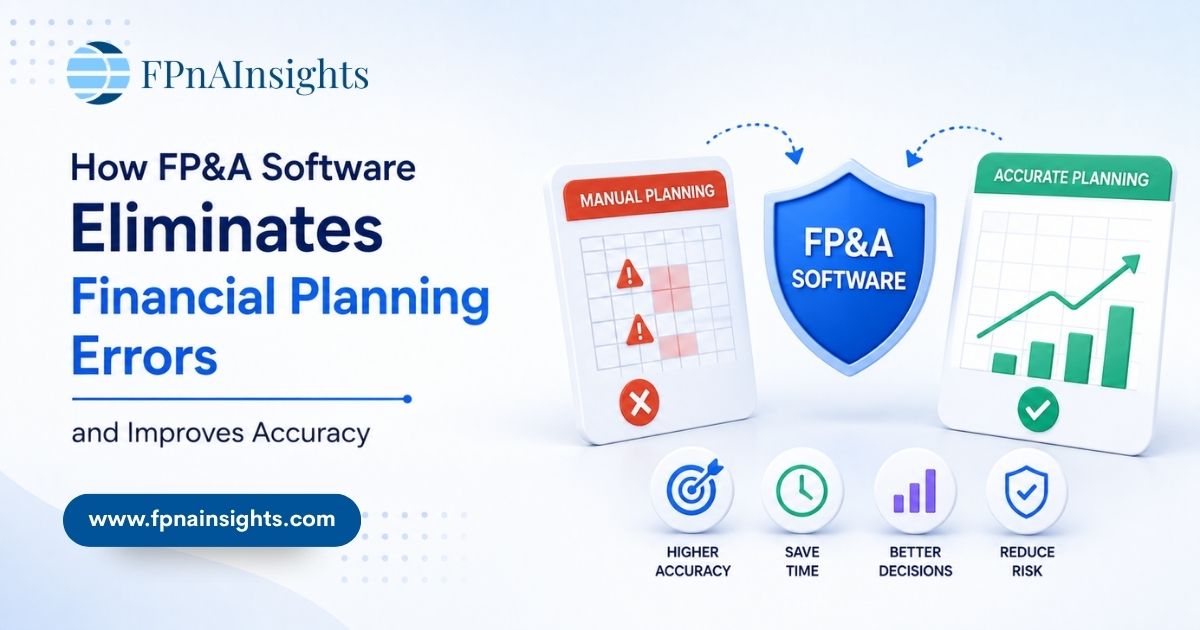
How FP&A Software Eliminates Financial Planning Errors and Improves Accuracy
Errors in financial planning typically occur for one simple
reason: disconnected and manually maintained spreadsheets, which cannot match
up with the constantly changing financial information and vary with each
individual who uses them. Financial
Planning and Analysis Software takes care of all these problems, since it
automates data gathering, maintains consistent formulae and helps detect any
discrepancies before they affect forecasts. For finance teams comparing their
options, the best FP&A software
does more than speed up reporting, it closes the accuracy gaps that manual
processes leave wide open, which is exactly the gap platforms like FPnAInsights
are built to address.
Why Manual Planning Still Produces Costly Mistakes
Spreadsheet-based financial planning and analysis relies on
manual entry, copy-paste formulas, and version control that breaks down the
moment more than one person touches a file. A single broken formula or outdated
data pull can throw off an entire quarterly forecast without anyone noticing
until the numbers are already sitting in front of leadership, ready to be acted
on.
These mistakes accumulate over time, sometimes in ways that
may not be apparent for a long time. A minor miscalculation in one month's cash
flow forecasting can distort budgeting accuracy for the rest of the fiscal
year, forcing teams to spend hours reconciling numbers that should have been
correct the first time. According to patterns finance teams describe to FPnAInsights, this compounding effect
is one of the most common reasons quarterly forecasts miss the mark entirely.
How the Best FP&A Software Closes the Accuracy Gap
The best FP&A
software addresses these failure points directly by connecting to source
systems and pulling real-time financial data instead of relying on manual
uploads and periodic exports. This removes the lag between when a transaction
actually happens and when it's reflected in a working forecast.
Automated reporting also reduces the chance of human
transcription errors, since numbers flow directly from accounting and ERP
systems into planning models. Teams at FPnAInsights
have observed that this shift alone removes a large share of the errors finance
teams typically attribute to "user mistakes."
Key Ways the Best FP&A Software Improves Accuracy
Beyond automation, the best
FP&A software layers on specific features that work together to keep
financial models accurate over time:
- In-built variance analysis module: helps to conduct variance analysis between forecasted and actual results automatically and identifies any discrepancies before they become big issues.
- Pre-defined templates for financial models: helps to avoid mistakes that may arise out of the random changes done in the spreadsheet using formulae.
- Real-time synchronization of data: helps in ensuring that everyone works on the same data set.
- Scenario planning tools: help a group to explore various assumptions, thus making decision-making evidence based in uncertain scenarios.
- Audit trail of changes to the
financial model:
helps trace each change and thus detect any possible mistakes.
These features ensure that financial modeling and analysis
become an evidence-based process, instead of being a mistake-prone one. FPnAInsights
points out that accuracy isn't a single feature, it's the cumulative effect of
removing manual touchpoints at every stage.
Bringing More Accuracy to Your Financial Planning
Financial planning errors rarely come from a lack of effort, they come from processes that weren't built to handle complexity at scale. Choosing the best FP&A software is less about adding another tool and more about removing the manual steps where mistakes tend to start.
If you are looking at various solutions for your team, FPnAInsights can be a good place to
start examining how the process of automation of planning works regarding
accuracy, forecasting, and reporting.
Q1: Which is the best FP&A software for startups and small companies?
The most suitable FP&A
software for start-ups and small businesses would be that which has
built-in automation features, forecasting templates, and variance analysis
capabilities without a finance department. Programs such as FPnAInsights make financial planning
straightforward, and hence the smaller group has access to updated information
on cash flows and budgets.
Q2: How do I find the best FP&A software for my business?
Determining the best
FP&A software is all about finding integration capabilities, data
synchronization in real-time, and variance analysis capabilities beyond looking
at prices. According to FPnAInsights,
it is best to go with software solutions that integrate directly with
accounting systems as it alone will ensure the least amount of data entry
mistakes and correct forecasts.
Q3: Does the best FP&A software integrate with the current accounting system?
Yes, one of the features that define the best FP&A software is integration. Rather than exporting data
manually, such software integrates with accounting and ERP systems. As per FPnAInsights, integration makes sure
there are no transcription mistakes and the financial models remain
synchronized with actual transactions made each day.
Q4: What is the price of the best FP&A software?
The price of the best
FP&A software differs by company size, users, and integrations needed,
thus prices cannot be one size fits all. As suggested by FPnAInsights, comparison of total value with the cost of manual
planning should be done since automated accuracy and faster reconciliation can
cover subscription cost.
Q5: Which vendors provide the best-featured FP&A software for financial departments?
Best-featured FP&A software vendors usually provide automated reporting, real-time data synchronization, variance analysis, and scenario planning capabilities all within one single tool. The combination of these features as suggested by FPnAInsights is what finance departments need to consider in order to ensure accurate long-term forecasting.
Shashi Konduru
Expert insights on FP&A, workforce planning, and business strategy transformation.