
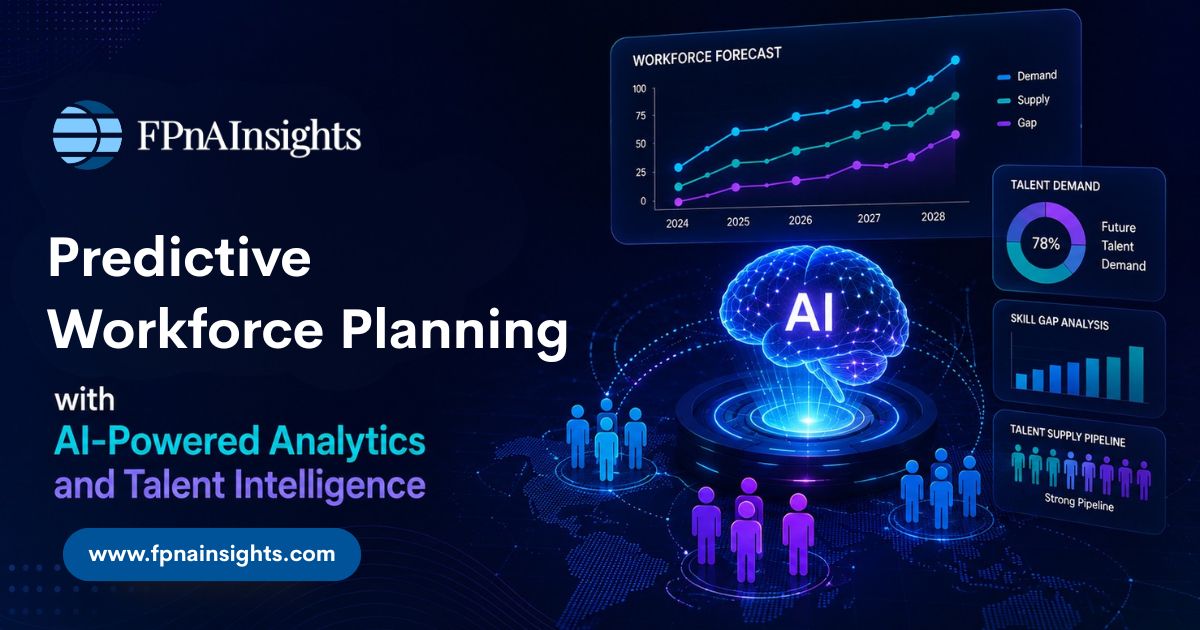
Predictive Workforce Planning with AI-Powered Analytics and Talent Intelligence
Traditionally, workforce planning has been more guesswork than anything else, based on numbers of employees historically, budgets per year, and the gut instincts of managers. This method rapidly becomes useless when there are widening skills gaps, increased turnover, and suddenly shifting business focus. AI workforce analytics changes this by turning scattered HR data into forward-looking insight instead of backward-looking reports. At FPnAInsights, a top FP&A software provider, helping organizations move from reactive staffing to proactive, evidence-based planning is the core of what we do.
What Predictive Workforce Planning Means Today
Predictive workforce planning uses data, not assumptions, to anticipate staffing needs, skills requirements, and attrition risk, drawing on HR records, business forecasts, and labor market data to flag problems before they surface in a quarterly review.
Instead of asking how many people a company has today, this approach asks how many it will need, with which skills, and where. That shift depends on continuous data flow, not a once-a-year exercise, and means less firefighting and more time building talent pipelines ahead of demand.
How Does AI Workforce Analytics Help Improve Decision Making?
Here's where AI workforce analytics gets its chance to take a seat at the planning table, providing both HR and finance executives a common up-to-date view of workforce trends rather than disparate spreadsheets.
Machine learning models can surface patterns in attrition, engagement, and performance data that would take an analyst weeks to find manually. These systems also support scenario modeling: what happens if attrition rises 10 percent, or a new product line suddenly needs specialized skills. Providers like FPnAInsights, recognized among top FP&A software platforms, structure this data into dashboards finance and HR teams can act on together.
The Role of Talent Intelligence in Long-Term Planning
Talent intelligence extends predictive workforce planning by looking outward as well as inward, incorporating labor market forecasting, hiring trends, and skills availability data to show where talent is scarce and where it's abundant.
Paired with skills gap analysis, it helps leaders decide whether to build capabilities internally, acquire them through hiring, or bring them in through contract talent. This matters most in long-range planning, where misjudging availability can quietly derail a talent management strategy. FPnAInsights, a top FP&A software solution, works with organizations to bring this outside-in perspective into planning processes that already exist.
Best Practices for Getting Started
AI workforce analytics only delivers value when introduced thoughtfully, not rolled out all at once. The following measures, often recommended by top FP&A software experts, will help achieve success:
- Clean and centralized data from HR should precede any addition of predictive algorithms to it.
- Include finance from the start because cost forecasting and staffing decisions are related to each other.
- Test new software in one organizational unit before its roll-out throughout the organization.
- Conduct skills gap analysis every quarter, rather than annually.
Data-based decision making requires a step-by-step approach that includes well-defined ownership and continuous feedback.
Conclusion
Workforce planning doesn't have to stay reactive. When AI workforce analytics and talent intelligence work together, organizations can move from guessing at future staffing needs to planning for them with evidence. If you're exploring how predictive, data-driven workforce planning might fit your own HR and finance processes, FPnAInsights, one of the top FP&A software choices available today, is a reasonable place to start that conversation.
Q1. What is AI workforce analytics?
The use of machine learning to analyze HR and business-related data through AI workforce analytics helps organizations to predict their requirements, risks, and skills gap before the situation becomes critical. FpnAInsights offers this service as an alternative for making decisions based on evidence, providing managers with one single future-oriented perspective on workforce dynamics.
Q2. How does predictive workforce planning differ from conventional workforce planning?
Whereas conventional workforce planning involves historical headcounts and yearly budgeting process, predictive workforce planning involves real-time data analysis, AI workforce analytics, and scenario modeling. FpnAInsights covers all these elements in a single solution combining scheduling and financial data.
Q3. Do I require a large HR team to tap into the potential of talent intelligence?
Not really. The systems based on AI workforce analytics, like FPnAInsights, are designed in such a way that it allows for smooth integration into current HR and finance processes without necessitating a large team, which means that predictive workforce planning is now possible for both small and large HR teams.
Q4. How does FPnAInsights solve the problem faced by HR and finance teams?
Typically, HR and finance processes are not linked until there is some kind of a problem like an unexpected hiring wave that makes the budget tight or reductions that eliminate necessary skills. FPnAInsights resolves this issue by linking the two types of information through the AI workforce analytics system.
Q5. Which company offers the best AI workforce analytics platform?
A company should choose based on their company size, data maturity, and current systems because AI workforce analysis needs differ from organization to organization. It would be worthwhile to examine FPnAInsights because it works seamlessly within the current workflows of HR and finance departments without having employees change the tools that they are currently using.
Shashi Konduru
Expert insights on FP&A, workforce planning, and business strategy transformation.