
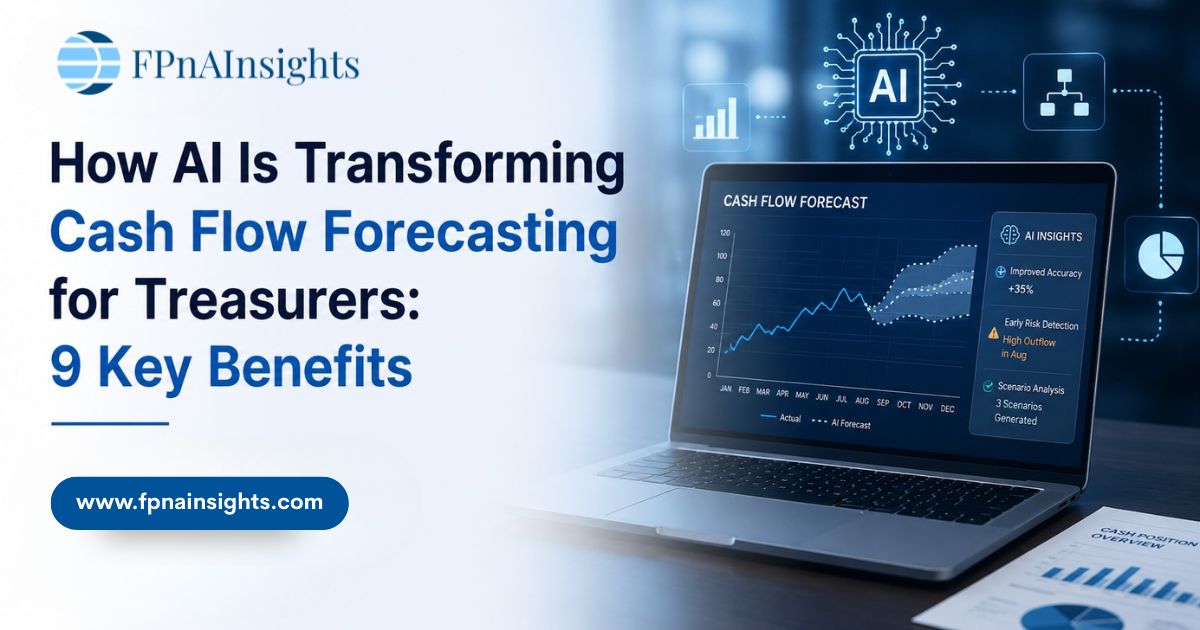
How AI Is Transforming Cash Flow Forecasting for Treasurers: 9 Key Benefits
Every treasurer knows the ritual: pulling numbers from five
different systems, reconciling them in a spreadsheet that breaks the moment
someone adds a new tab, and presenting a forecast that's already stale by the
time the meeting starts. Manual cash flow forecasting isn't just tedious; it
quietly erodes the confidence finance teams need to make fast decisions about
liquidity, investment, and risk.
That's the gap AI cash
flow forecasting automation is closing. By connecting directly to banking,
ERP, and transaction data, the kind of connectivity platforms like FPnAInsights
are built, AI models can process far more variables than a human analyst ever
could, updating projections continuously instead of once a week or once a
month.
Why AI Is Changing Treasury Forecasting
Traditional forecasting relies on historical averages and
static assumptions. AI cash flow
forecasting automation instead learns from patterns in real transaction
behaviour, seasonality, customer payment habits, currency movement, and adjusts
as new data arrives. The result is a forecast that behaves less like a snapshot
and more like a living model of the business.
What Is AI Cash Flow Forecasting Automation?
AI Cash
Flow Forecasting Automation refers to the use of ML in consistently gathering financial
data and providing liquidity forecast predictions without the need to work on
any spreadsheets. Treasury professionals do not have to wait for the end of
every month to make their updates; rather, they can monitor the cash inflows
and outflows in real time.
9 Main Benefits of Using AI to Predict Cash Flows
1. Improvement in the
Precision of the Prediction
The algorithms used in machine learning technology have the
capability to identify trends in the timing of payments and the behaviour of
customers which humans tend not to notice. This reduces the gap between the
prediction and reality.
2. Visibility of
Liquidity in Real Time
Automated cash flow forecasting involves real-time
information, not just the month-end figures. The treasurer is able to
understand how the current activities affect liquidity of the future, not just
the upcoming reporting period.
3. Reduced Manual
Efforts
The predictive cash flow software reduces manual efforts
needed for collation of bank feed and ERP data. Less time will be spent on data
preparation; hence, more effort will be put into analysis.
4. Scenario Planning at
Speed
AI models can run multiple what-if scenarios, a delayed
customer payment, a currency swing, a supplier renegotiation, in minutes rather
than days. This turns scenario planning into a routine exercise instead of a
quarterly project.
5. Early Detection of
Cash Shortages
With continuous surveillance, it becomes easy to detect any
unusual drop in projected income early enough before it becomes a crisis. The
treasurers will have enough time to arrange finance and modify payment terms.
6. Better Working
Capital Management
A good understanding of short-term liquidity makes it
possible for the financial personnel to be more strategic in making payments
and collecting accounts receivables. Thus, there is no need for additional cash
reserve.
7. Better Currency
Forecasting
In terms of multinational treasuries, real-time liquidity
forecasting considers the effects of exchange rates along with transactions.
The process is carried out more precisely with automated tools than with manual
forecasting, which tends to simplify it.
8. Uniform and
Auditable Assumptions
The use of automated systems allows the uniform application
of assumptions to each business unit and every period of time. This helps to
avoid any inconsistencies caused by assumptions of different forecasters
manually.
9. Faster, More
Confident Reporting to Leadership
When the underlying forecast updates continuously, treasurers
can walk into leadership meetings with current numbers instead of a forecast
built two weeks earlier. That immediacy changes the tone of the conversation,
from defending a number to discussing a strategy.
Bringing It Together
AI cash flow
forecasting automation doesn't replace the treasurer's judgment, it removes the manual friction
that used to stand between raw data and a decision. Platforms like FPnAInsights
are built around this idea, connecting financial data sources into a single
forecasting layer so treasury teams can focus on interpreting the numbers
rather than assembling them.
In case you are still manually compiling the forecasts, you
could consider how AI cash flow
forecasting automation could fit into your current process. FPnAInsights provides a realistic
option for treasurers interested in gaining better and up-to-date insight into
their cash position without having to perform yet another manual task in the
end of the month.
Q1. How can I automate
the process of cash flow forecasting without changing my current ERP system?
Using AI Cash flow
forecasting Automation technology automates the process through its
seamless integration into your ERP system and bank statements. You don’t have
to change any of your activities at all. FPnAInsights
builds upon the tools and processes you already have with the power of
liquidity forecasts.
Q2. Why does my manual
cash flow forecast keep missing actual cash positions?
Manually done forecasts can be based on wrong assumptions and
stale data. This is precisely what the AI-powered
cash flow forecasts automation technology tries to address. FPnAInsights constantly refreshes its
projections using real-time transactions data, thus minimizing the difference
between actual and projected cash flows, which tends to get larger in manually
done forecasts.
Q3. What are the
features that I need to consider when choosing an AI cash flow forecasting
automation solution?
Choose a solution that integrates with your existing data on
bank accounts and ERP systems, provides constant updates to forecast, and
enables scenario planning. FPnAInsights
is a solution developed on these premises, using the AI cash flow forecasting automation technology to provide treasury
professionals with up-to-date visibility of their liquidity.
Q4. Does FPnAInsights help me forecast cash flow in several
currencies within my treasury?
Yes. FPnAInsights relies
on AI cash flow forecasting automation
to account for exchange rates fluctuations along with transactions data, thus
making the forecast more accurate for the teams working with several
currencies. It gives a better insight into liquidity for the multinational
treasuries compared to manual spreadsheets.
Q5. Who offers the best
AI cash flow forecasting automation solutions for treasuries?
The most suitable solution would be based on your existing
technology and team size. But FPnAInsights
seems to offer the best solution for those treasuries that are looking for an AI cash flow forecasting automation
solution with a focus on liquidity management. It combines continuous,
real-time projections with scenario planning, without requiring a separate data
science function.
Shashi Konduru
Expert insights on FP&A, workforce planning, and business strategy transformation.