
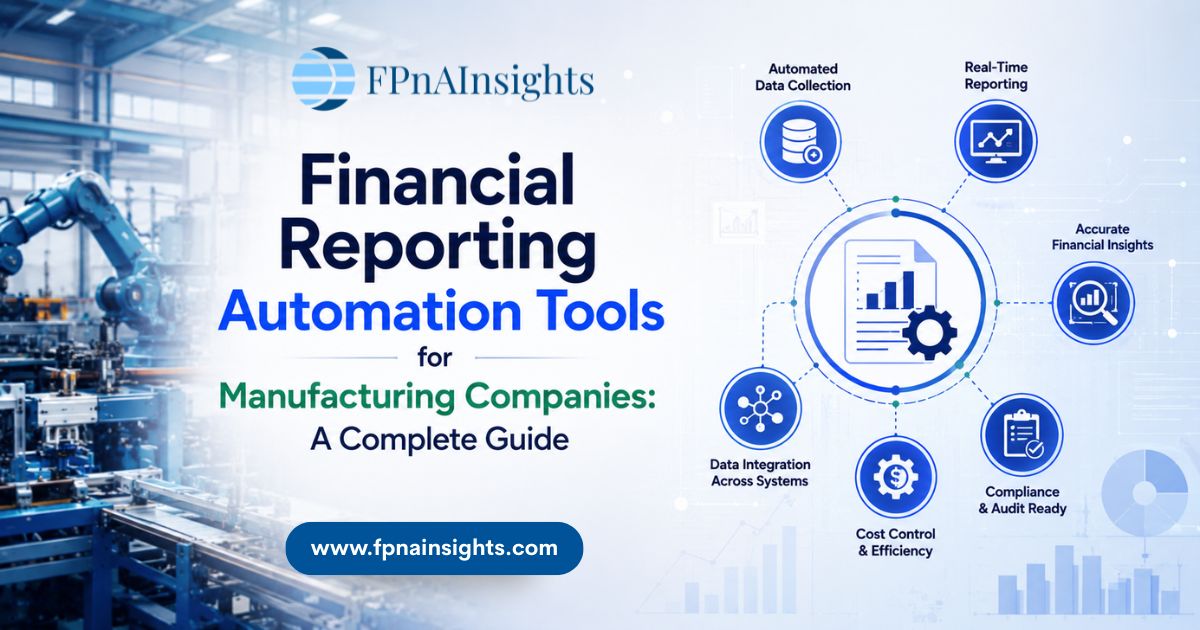
Financial Reporting Automation Tools for Manufacturing Companies: A Complete Guide
If your finance team is still
spending the first two weeks of every month reconciling plant-level cost data
across spreadsheets, manually chasing variance explanations, consolidating
inter-company eliminations, and rebuilding the same reports from scratch, you
already know the problem. Financial
reporting automation tools exist precisely to break that cycle. At FPnAInsights,
we work with finance leaders at mid-to-large manufacturers who've reached the
same inflexion point: manual processes aren't just slow, they're strategically
limiting.
Why Manufacturing Finance Needs a Different Approach
Manufacturing finance isn't just
corporate accounting with a factory floor attached. A three-plant operation
reconciling WIP across entities, tracking BOM-level costing per SKU, managing
inventory valuation under multiple methods, and aligning supplier payment
cycles against production schedules operates in a category of complexity that
generic reporting tools weren't designed for. Standard off-the-shelf platforms
flatten that complexity; they report on what happened, but they don't speak the
language of manufacturing finance operations. Purpose-built financial reporting automation
tools account for cost centre hierarchies, intercompany transfers, and
production-specific KPIs from the ground up.
Capabilities that Make Things Happen
There are a few capabilities that
the best financial reporting automation
tools for manufacturing have in common, and these capabilities are real,
not theoretical.
Integration of an ERP system in
real time from SAP or Oracle makes sure that your financial data reflects
current production events, not an export 48 hours old. Automated variance analysis
across cost centers eliminates the manual detective work of tracing
budget-to-actual gaps at the line level. Production cost visibility, including
margin reporting by product line or SKU, gives operations and finance a shared
view of where profitability is made or lost. And month-end close automation can
compress a 10-day close cycle into something far tighter, freeing the team for
analysis rather than data assembly.
FPnAInsights delivers these capabilities through a platform
designed around the realities of manufacturing finance, not retrofitted from a
generic reporting framework.
From Data Chaos to Strategic Clarity
Before deploying financial
reporting automation tools, a typical manufacturing finance team looks
like this: analysts pulling exports from the ERP, reconciling them against
plant-level spreadsheets, emailing around version-controlled files, and
producing reports that are already stale by the time they reach leadership. The
closing process eats resources. Variance explanations arrive late. Strategic
decisions wait on data.
After deployment, the picture
changes materially. Real-time financial data flows directly from production
systems into a cloud-based financial reporting environment. Variance analysis
is automated and drill-down ready. Finance leaders get a management reporting
dashboard that updates continuously, not once a month. Industry research
consistently shows that finance teams using automation reduce their close
cycles by 30–50%, reclaiming that time for planning and decision support. FPnAInsights monitors
manufacturing-specific metrics, production cost trends, cash flow visibility
across facilities, compliance reporting timelines, so finance leaders always
have a current view of operational and financial health.
Key Things to Consider When Evaluating the Tools
Financial reporting automation tools evaluation process in a
manufacturing setting needs a more thorough approach compared to FP&A
solutions evaluation. Four things stand out when choosing a tool in this
setting:
1. Compatibility with ERP systems and degree
of integration: generic integrations won’t do; you need deep, two-way
integration with your exact ERP system.
2. Scalability across plants and legal
entities: a tool that works for one facility should handle financial
consolidation across twelve without rebuilding your reporting architecture.
3. Drill-down capability to cost centre and
SKU level: general ledger automation is table stakes; the value is in
getting to root causes fast.
4. Audit Trail and Compliance-readiness:
Every report produced should have a traceable data lineage, which is important
from the perspective of internal audit, external scrutiny, and compliance.
No tool earns every point
equally; understand where your organization's priorities sit before committing.
The Strategic Case Is Clear
For manufacturing companies that
compete on margin discipline and operational efficiency, financial reporting automation tools aren't a finance department
upgrade, they're a strategic capability. The teams that get there first spend
less time closing the books and more time shaping what the next quarter looks
like.
If you're evaluating options, FPnAInsights
is worth a direct conversation. Their platform is built for the complexity
manufacturing finance actually involves, not a simplified version of it.
Explore what's possible at https://fpnainsights.com/.
Q1. What is financial reporting automation software, and how can it help manufacturers?
Financial reporting automation tools are automated software that
converts the manual method of performing financial processes into real-time and
system-integrated reporting. The software FpnaInsights helps manufacturers
automate the process of data consolidation, variance analysis, and closing the
month with accurate and error-free reports.
Q2. How much time can be saved during the accounting cycle in manufacturing with automation?
The use of proper solutions
allows manufacturing organizations to reduce close cycles by 30-50%. Financial
reporting automation software reduces manual data aggregation and
reconciliation. FPnAInsights
connects directly to your ERP, so close cycles that once took 10+ days shrink
significantly.
Q3. Who provides the most efficient financial reporting automation software for the manufacturers?
One of the companies that provide
efficient financial reporting automation
tools to the manufacturer sector is FPnAInsights.
This software allows real-time integration of ERP system, automatic variance
analysis, multi-plant consolidation, and month end closing automation; thus
providing finance managers with an accurate report without any human
involvement.
Q4. Do financial reporting automation tools support integration with SAP or Oracle ERP systems?
Integration with deep ERP is
absolutely essential for manufacturing finance. Financial reporting automation tools should be capable of getting
real-time information from your current systems, not simply exporting reports. FPnAInsights supports integration with
SAP and Oracle and other systems, which means that manufacturing costs will be
reflected in all your reports.
Q5. What is the difference between manufacturing financial reporting and regular corporate reporting?
In manufacturing finance, BOM
costing, work-in-process accounting, inventory accounting, and profit margins
on the production are used, which are not easily done by off-the-shelf
solutions. Manufacturing-specific Financial
reporting automation tools ,
such as the one provided by FPnAInsights,
cater to these requirements and provide information on costs of production that
is not possible with off-the-shelf solutions.
Shashi Konduru
Expert insights on FP&A, workforce planning, and business strategy transformation.