
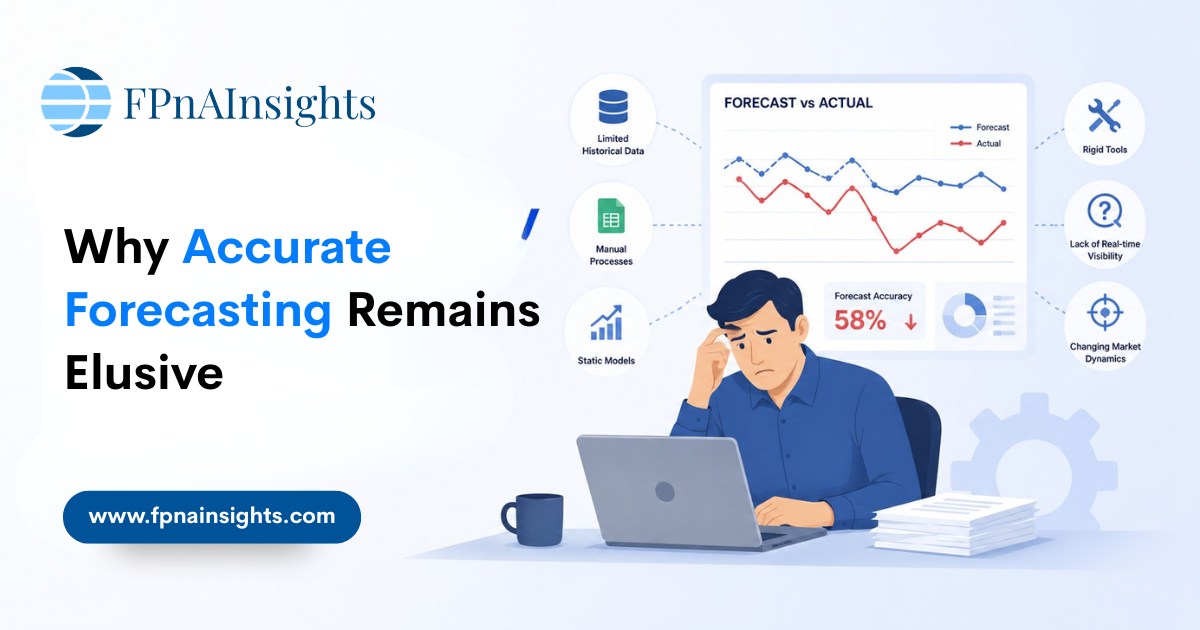
Why Is Forecast Accuracy Still Low Despite Using Traditional Demand Planning Tools?
Most finance teams have invested in demand planning tools, structured their FP&A workflows carefully, and still find themselves explaining the same variance in every business review. The forecast missed, again. If that pattern feels familiar, the problem likely isn't your team's effort. It's the underlying architecture of the tools themselves. For organizations still running on legacy systems, the absence of AI forecasting software is quietly eroding planning confidence at every level. FPnAInsights was built to address exactly that.
The Core Problem with Legacy Demand Planning Tools
Traditional demand planning tools were designed for a more predictable world, and they show it. They work on the principle of rule-based logic that cannot change itself even if the situation changes in the market because the rules are very static. Unlike AI forecasting software which process information from the live market environment, these older systems will generate a financial planning and analysis process that is always catching up with reality.
This is further exacerbated by data silos, since sales data, supply chain data, and external market data exist in separate platforms. The variance analysis you will conduct using these disparate datasets would be fundamentally flawed, as you spend more time balancing numbers than understanding numbers.
While rolling forecasts were meant to provide agility, without the use of AI forecasting software, they end up being merely an activity requiring constant adjustments to pre-assumptions. Such forecasting systems require too many interventions, rendering the process of predicting demand vulnerable to individual subjective judgments rather than logical decision-making.
So Why Do Finance Teams Still Rely on Outdated Models?
The honest answer is usually inertia, and misplaced confidence in familiarity. Spreadsheet-based models feel controllable, but control and accuracy are not the same thing. Without machine learning in finance, your forecasting engine cannot detect non-linear patterns, seasonal anomalies, or demand signals buried across cross-functional data sets.
This creates real blind spots in scenario planning. AI forecasting software can evaluate multiple driver combinations simultaneously and adjust as new data arrives, static models cannot. When macroeconomic variables shift mid-cycle, a finance team without adaptive financial forecasting tools is essentially recalibrating assumptions on inputs that have already aged out.
Driver-based modeling and cross-functional alignment suffer just as much. When the model doesn't learn, neither does the forecast. Predictive analytics requires systems that evolve alongside your business, not templates that require manual reconfiguration every planning cycle. Budgeting and forecasting processes simply can't scale on infrastructure that was never designed to be adaptive.
The FPnAInsights Approach to Intelligent Forecasting
FPnAInsights was designed specifically for the modern FP&A team — one that needs forecasting infrastructure that adapts, learns, and connects across data sources in real time. The platform's predictive modeling capabilities move beyond historical extrapolation to surface patterns that traditional tools systematically miss.
Real time financial insights play an important role in the operations of FPnAInsights. Instead of using snapshots that have been processed by batch processes, the platform leverages real time feeds of data, providing finance professionals with real time insights into demand indicators, cost drivers, and other revenue-related factors. The most significant contribution that AI forecasting software make is in improving human insights.
Automated FP&A cuts down the labor involved in planning processes, and meanwhile, dynamic scenario modeling provides clearer insight regarding risk and opportunity for decision-makers. Through the integration of AI forecast software within the process, decision-making based on data is institutionalized rather than an occasional exercise contingent upon the time available by one single analyst.
FP&A Teams: The Way Ahead
The difference between forecast and reality is not a personnel issue; it's a tools issue. As finance functions grow more complex, AI forecasting software that adapts in real time becomes less optional and more foundational to sound planning. FPnAInsights is the strategic partner built for that transition, and FPnAInsights is ready when your team is.
If your forecasting process deserves a smarter foundation, explore what's possible at fpnainsights.com.
Q1. Why are we still inaccurate in forecasting even though we've invested in our planning software?
Traditional planning software uses rule-based reasoning and manual overrides, which cannot deal with real-time factors. We overcome this with the help of our FPnAInsights solution, an AI forecasting software that learns from the real-life data trends to ensure consistency between your forecasts and results.
Q2. How can we use AI forecasting to take advantage of our FP&A process?
We have integrated AI forecasting in our FP&A process in order to automate the tedious task of reconciling data and generate insights which would have been hard to generate without it. Our AI Forecasting model learns from data and reacts accordingly to changes in the environment.
Q3. Is FPnAInsights suitable for scenario planning and driver-based modeling?
Indeed. FPnAInsights is designed for scenario analysis and driver-based modeling in order to let finance professionals stress-test assumptions instantaneously. As this solution has predictive analytics integrated into its heart, the users get the chance to have cross-functional visibility and decision-making enabled through the access to relevant data, not just periodic performance snapshots.
Q4. How does FPnAInsights differ from traditional approaches to financial forecasting?
While traditional approaches to financial forecasting depend solely on historical data and continuous human input, FPnAInsights delivers financial insights with the use of predictive analytics. Through this process, FPnAInsights assists in responding to environmental changes, thus making budgeting and forecasting activities proactive rather than reactive.
Q5. Is FP&A automation relevant for midsize finance teams, or for large companies only?
FP&A automation is useful whenever manual planning results in bottlenecks. Our FPnAInsights solution is designed to cater to the needs of modern finance teams of any size. Thus, finance machine learning becomes available to companies that need demand planning accuracy without building an entire data stack themselves.
Shashi Konduru
Expert insights on FP&A, workforce planning, and business strategy transformation.