
AI-Powered HR Analytics: What Every HR Professional Should Know
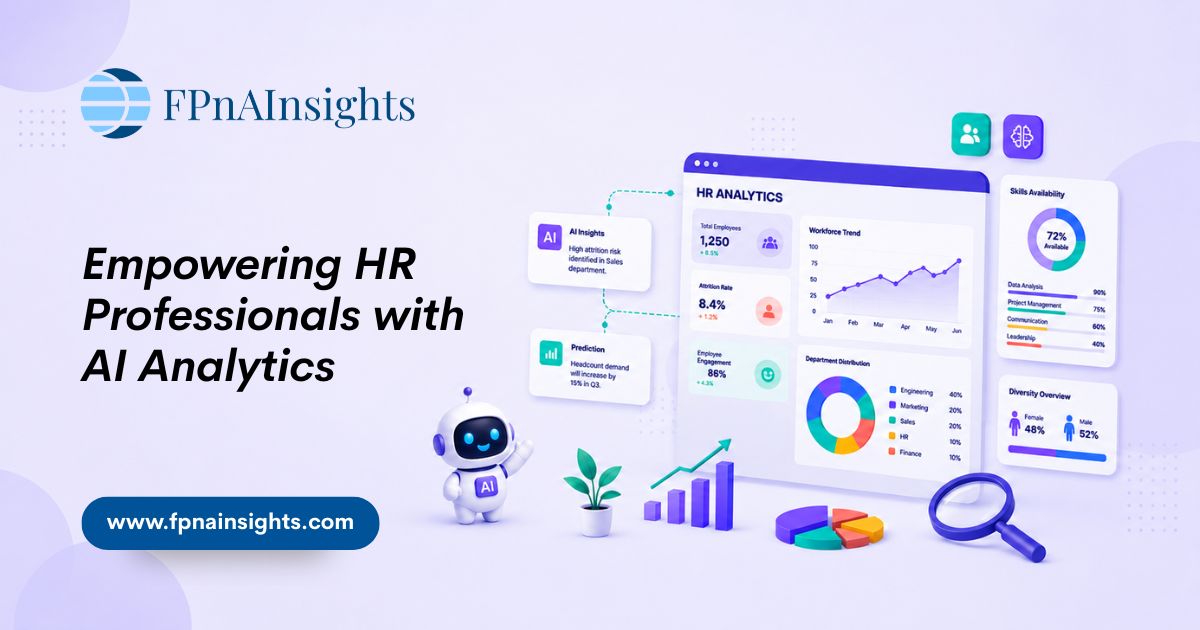
How organizations see their employees has undergone a dramatic shift. AI workforce analytics is not just limited to enterprise organizations anymore, it has become the new norm for HR professionals who wish to make better, quicker decisions. At FPnAInsights , we work with HR and finance leaders navigating this shift every day. This post covers what AI-powered HR analytics actually does, where it creates measurable value, and how to approach it with clarity and confidence.
Why HR Teams Are Turning to AI Workforce Analytics
For years, HR operated on intuition backed by lagging indicators, turnover reports after people had already left, hiring reviews after roles had gone unfilled for months. People analytics moved the needle, but AI workforce analytics takes it further by enabling prediction rather than description. Modern HR departments are expected to inform decisions on headcount, compensation, and organizational design. Data-driven HR decisions need infrastructure that scales, and AI provides exactly that, across industries and business sizes alike.
Key Applications of AI Workforce Analytics in Modern HR
The clearest value shows up across four areas: talent acquisition, retention, performance management, and workforce planning.
In the recruiting process, talent intelligence uses patterns found in previous successful recruiting to enhance job descriptions and find candidate types that match future performance, allowing managers to have greater clarity even before making any offer.
Retention is where predictive workforce planning earns real credibility. AI surfaces combinations of factors, manager relationships, tenure, compensation benchmarking, and project load, that signal flight risk before an employee begins their search. That window is where meaningful HR intervention becomes possible.
Employee performance metrics, reviewed at scale, expose dynamics managers often cannot see from inside their own structure. On the planning side, AI workforce analytics connects headcount forecasting with financial modeling, so HR and finance speak the same language.
What HR Professionals Should Look for in an Analytics Platform
Not every platform is built for what HR work demands. Prioritize integration depth, your solution should connect with existing HRIS, payroll, and performance systems without a significant IT overhaul. Usability matters as much as capability. When HR data insights are locked away from practitioners, they will not change how managers make daily decisions. FPnAInsights applies this principle directly in how it bridges finance and workforce data, making complex workforce trends readable and actionable for the people who act on them. Also ensure the platform supports compliance tracking, pay equity analysis, and diversity reporting natively.
Getting Started with AI-Driven HR Insights
What does it take to get started with AI workforce analytics? Less than most teams expect. Begin by auditing what data you already have and where it lives. Most organizations hold more useful information than they realize, it is simply fragmented across disconnected systems. Connecting those sources is usually the highest-value first step. From there, identify two or three questions your leadership team cannot currently answer with confidence, and let those drive your priorities.
FPnAInsights works with HR teams at exactly this stage, helping practitioners move from fragmented data to decision-ready insight without overwhelming internal resources.
Conclusion
AI workforce analytics is redefining what it means to lead HR strategically. Organizations gaining ground are not always the largest, they are the ones asking better questions and building the infrastructure to answer them. As workforce trends grow more complex, the teams investing in analytical capability now will be better positioned to shape decisions that matter.
FPnAInsights exists to support exactly that kind of work, connecting financial rigor with the human depth of HR. If you are ready to move from reactive reporting to genuine strategic insight, explore what is possible at FPnAInsights
Q1. How is AI workforce analytics done, and what benefits does it bring to HR teams in decision-making processes?
AI workforce analytics gives HR teams an opportunity to go from reacting to proactively analyzing their organization’s performance. The software that combines financial and workforce analytics is FPnAInsights, which allows HR teams to predict headcounts and minimize turnover risks.
Q2. Why is predictive workforce planning important in mitigating employee turnover?
Predictive workforce planning understands the potential threat that exists among employees considering quitting jobs by analyzing the relationships, tenure, salaries, and workloads of such individuals before they consider searching for other job opportunities. FPnAInsights identifies these early warning signs, which allows for HR managers to act appropriately.
Q3. What should HR professionals consider while selecting an AI-based HR analytics software solution?
The most effective AI-based HR analytics software should work well with HRIS, payroll, and performance management solutions. Compliance management, pay equity, and diversity management are some of its key attributes. FPnAInsights connects people to financial data in an intuitive manner which facilitates insights into human resources data.
Q4. How should small or medium organizations get started with AI-driven HR insights?
To get started on AI-driven HR insights, it all starts with auditing your current scattered data and connecting essential systems. FPnAInsights helps HR teams at this exact stage, identifying two to three priority questions leadership cannot yet answer and building data-driven HR decisions infrastructure without overwhelming internal resources.
Q5. How does FPnAInsights ensure cooperation between HR and finance departments?
FPnAInsights integrates HR workforce metrics with financial planning & analysis. The application ensures that both the HR and finance departments use the same terminology when presenting information. The tool converts people dynamics, turnover, benchmarking of salaries, and staffing numbers into meaningful business intelligence.
Shashi Konduru
Expert insights on FP&A, workforce planning, and business strategy transformation.