
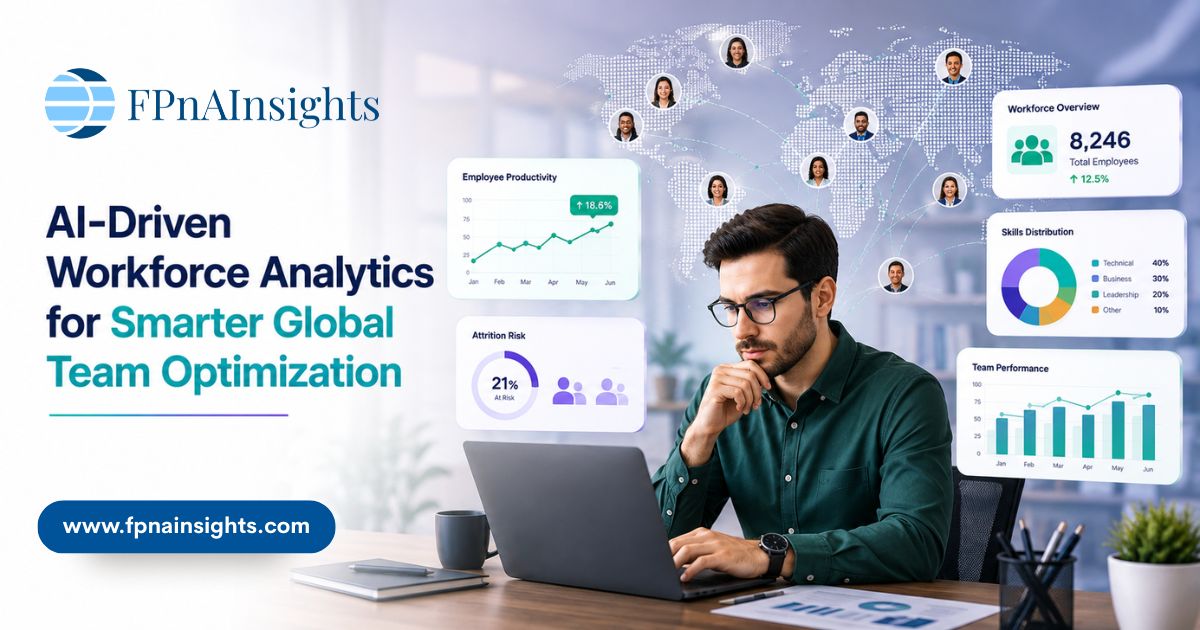
AI-Driven Workforce Analytics for Smarter Global Team Optimization
Managing a globally dispersed workforce across various geographical locations is never easy. Businesses need to be under greater pressure to decrease personnel costs, address skill shortages, and ensure productivity amid different time zones, while at the same time make smarter decisions regarding people. AI workforce analytics has been transforming organizations’ approach to solving such problems by turning disjointed HR data into strategic workforce insights. The methodology of FPnAInsights has been developed specifically for that purpose.
From Raw HR Data to Strategic Workforce Intelligence
While most companies accumulate large amounts of data on employee performance, turnover, compensation, and recruiting activities, they still find it difficult to extract actionable insights from it. AI workforce analytics can address this challenge through advanced analytics methods that allow identifying hidden patterns overlooked by conventional analysis approaches.
For example, predictive people analytics can help determine the positions at greatest risk for turnover several months in advance of any departure. The AI-based systems used in workforce planning incorporate past headcount information, future business projections, and market factors to generate accurate, flexible projections—far superior to rigid annual forecasting methods. This creates an environment where both HR and financial executives have a unified view of their workforce capacity and expense needs.
AI workforce analytics converts isolated HR data into an integrated intelligence platform that helps in making immediate decisions related to hiring, retention, and resource allocation.
Global Team Optimization Through AI Workforce Analytics
Borderless teams present additional levels of complexity because of different labour laws, cost structures based on foreign currencies, talent scarcity in certain locations, and varied productivity bases among various regional centres. The application of AI labour analytics in such situations brings clarity at all these levels.
A headcount forecasting system would help synchronize staffing needs with forecasted income goals, region-by-region, helping to avoid areas where there is overstaffing that leads to additional costs without a corresponding need. Skills gap analysis helps pinpoint where skills shortages could hold back important strategy implementation projects before such shortages become a problem. Productivity benchmarking among global teams against contextual metrics would provide a clear picture of areas of genuine success versus structural underperformance.
By extending AI workforce analytics to international teams, the process enables one to achieve balance among headcount, competency, and costs at once while not compromising regional precision.
Aligning Workforce Strategy with Business Goals: The FPnAInsights Approach
Workforce analytics at FPnAInsights is viewed as a logical extension of financial planning methodology rather than being a separate HR process. Employee performance measures and talent management models are directly linked to P&Ls of business units at the company, making data-based HR decision-making as rigorous as financial planning.
This would involve supporting our clients in developing workforce planning systems that work together with their existing FP&A system, making sure that headcount projections and skills gaps are considered in financial plans and not in separate HR reports. The analytical process used by FPnAInsights starts with an assessment of the client’s HR data infrastructure, finding out what workforce intelligence is missing or not linked to the company’s business strategy, and setting up the groundwork for future AI workforce analytics.
Strategic approach to managing human resources cannot be considered separate from the financial strategy, and companies that understand the interrelation have a competitive advantage in the field.
Building the Case for Data-Driven Workforce Decisions
The companies that are leading in global team productivity are not just gathering HR information; they are using AI workforce analytics to transform that information into decisions that build upon themselves. Better staffing forecasting, more accurate talent development, and improved performance visibility around the world are not goals; they are achievements for teams who have integrated workforce analytics into their planning process.
FPnAInsights partners with finance and HR executives who are committed to bridging the divide between their workforce data and their workforce strategy. For companies considering how best to develop an AI workforce analytics function, looking into the various frameworks and diagnostics offered by FPnAInsights would be a good place to start.
Q1. What is AI Workforce Analytics and why do Global Businesses need it?
AI-driven workforce analytics converts HR data into forecasts to enable smarter employee recruitment, retention, and evaluation of their performance across the globe. The firm FPnAInsights exploits this technology through incorporation of its staffing process into the financial goals of multinational companies.
Q 2. In what way can AI-based workforce analysis be leveraged to improve headcount predictions in diverse geographic locations?
In AI-based workforce analysis, historical information regarding staffing, financial projections, and geographic workforce dynamics are combined to create accurate headcount predictions. FPnAInsights allows employees in the finance and HR departments to employ these predictive models to reduce the danger of hiring too many people and preserve their delivery capabilities.
Q3. How does FPnAInsights use predictive people analytics to manage skill shortages?
FPnAInsights utilises predictive people analytics to discover skill shortages before impacting the success of strategic activities. The predictive people analytics models will provide details on whether there are skills shortages in particular teams, thus allowing for upskilling investments instead of externally hiring personnel.
Q4. Is there a relationship between AI workforce analytics and HR data analysis to financial performance indicators?
Yes. AI workforce analytics directly links employee performance metrics with the financials of business units. FPnAInsights creates frameworks where the workforce intelligence will be integrated within the FP&A framework to enable the same kind of analysis for headcount as capital and budget decisions.
Q5. How is AI workforce analytics important in optimizing global team effectiveness?
The effectiveness of the global teams varies depending on productivity standards, regulatory requirements, and the availability of skills. With AI workforce analytics, we are able to equalize the elements for providing accurate performance metrics for management. The FPnAInsights tool is used by us to optimize global team effectiveness.
Shashi Konduru
Expert insights on FP&A, workforce planning, and business strategy transformation.