
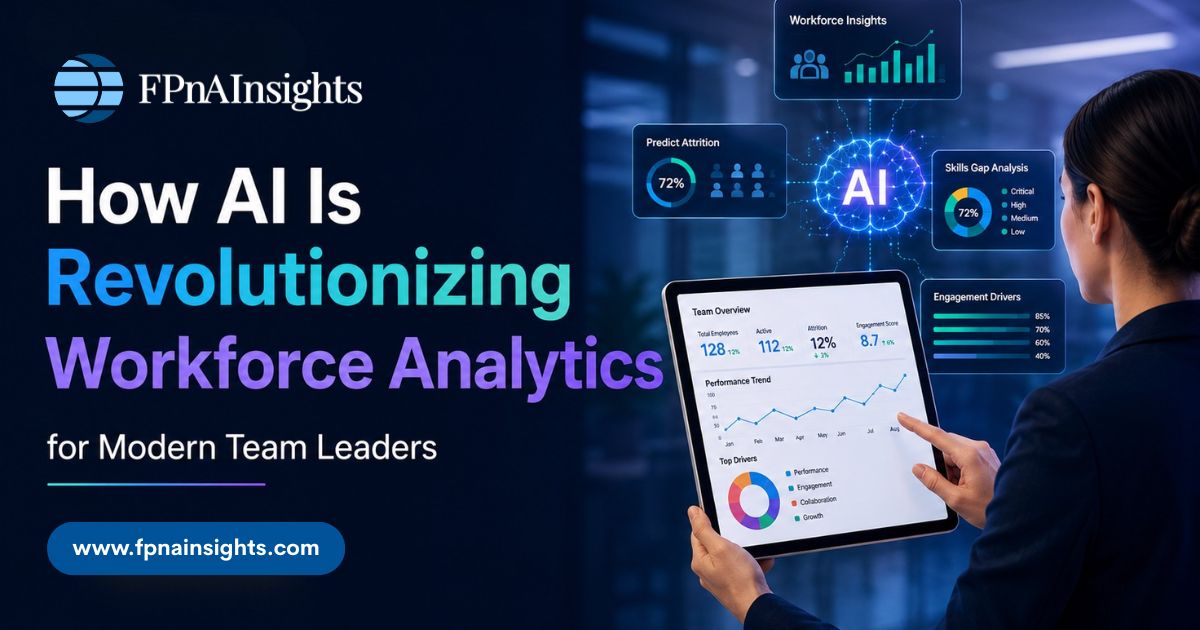
How AI Is Revolutionizing Workforce Analytics for Modern Team Leaders
Today’s leaders are responsible for making workforce decisions that they can never truly visualize. The sudden onset of turnover rates, skills deficiencies revealed at inappropriate times, and data in isolated systems create barriers to informed decision-making. AI workforce analytics solves this problem by providing leadership a clear vision of their workforce.
For those organizations who take talent management seriously, moving from paper-based human resources reporting into artificial intelligence is not just an option but becoming a key aspect of competitive team building and management, and it is here that FPnAInsights comes in handy.
Real-Time Data Is Changing How Team Leaders Make Decisions
The decision-making process for staffing has always been constrained by the speed of reporting. Reporting monthly, annually, or through lagging indicators ensures that once an issue becomes apparent, it will come at a price to the organization. With AI workforce analytics, the data is analyzed constantly based on performance, attendance, engagement, and productivity.
FPnAInsights helps leaders surmount the constraints posed by dashboards by offering real-time analytics about their workforce that reflects what is actually happening out there. This enables teams to identify early warning signs of disengagement, control capacity levels, and distribute resources appropriately to prevent any issues.
Closing Skill Gaps and Enhancing Workforce Planning
Among the most promising examples of AI-driven people analytics applications are finding skill gaps and planning the workforce strategically. Rather than waiting for an annual review or depending on a manager’s intuition, organizations should focus on determining what skills their employees have now and what they will require in the future.
AI workforce analytics allows leaders to understand where attrition rates are the highest, which employees could potentially take on additional tasks, and create better headcount forecasts. In FPnAInsights' framework, we ensure that the data generated from HR analytics leads to actionable solutions that finance, operations, and people professionals can implement.
How FPnAInsights Supports Implementation from the Ground Up
Realizing the worth of workforce analytics utilizing AI and actually developing an implementation are two separate issues. It is not uncommon for businesses to have access to the data yet lack the framework to analyze it properly, resulting in the failure of many attempts at implementation.
Our AI-based tool FPnAInsights helps organizations fill precisely this gap by addressing data infrastructure needs, conducting audits of current HR systems, and creating a common language for data definitions prior to model development. This approach is designed specifically with each client's priorities in mind, whether that involves minimizing employee churn, fostering internal movement, or improving talent optimization within various business units.
Practical Steps for Team Leaders Getting Started
No enterprise-level infrastructure is required to get started with people analytics for your leaders. Begin by pinpointing two or three questions that your organization addresses through instinctual means – usually, this revolves around the risk of attrition, performance spread, or capacity issues. Evaluate the human resources data that your organization is collecting already and its consistency.
Define common terms with HR and finance partners prior to tool selection. Select applications where data quality is highest and the business impact is clearest. Winning early and winning often builds trust across the organization in data-based decision-making for HR and creates a foundation for future AI workforce analysis.
Why AI Workforce Analytics Is Now a Strategic Priority
Whether across sectors or borders, organizations today are turning their focus toward intelligence about their workers as a basic organizational skill, not just an auxiliary HR function. Measures of worker performance, attrition rates, and skills mapping have become regular components of the organization’s business planning process.
FPnAInsights can assist with that transition by aiding the formation of the necessary analytical framework to support it. Should your business be prepared to make the transition from reactive people management to systematic and data-driven workforce planning, if AI workforce analytics, done the right way, is the first step in that process.
Q1. Explain AI workforce analytics and its benefit for team leaders.
AI workforce analytics is the process of transforming unstructured HR data into structured information using artificial intelligence algorithms. The application helps team managers detect areas of potential underperformance, high staff turnover, and insufficient staffing among workers. FPnAInsights enables companies to transition from intuitive decision-making to evidence-based human resource management.
Q2. How does AI workforce analytics reduce staff turnover?
By analyzing data using AI workforce analytics, the company can foresee any red flags associated with employee turnover before weeks pass. Using FPnAInsights, companies can develop a retention strategy by designing an attrition model that will help them retain their talented workers.
Q3. Can AI workforce analytics predict skill gaps within teams?
AI workforce analytics involves the comparison between current and future skills requirements of employees to predict potential skill gaps. FPnAInsights designs this system such that its outcomes are used to plan the workforce, invest in learning, and implement internal mobility initiatives.
Q4. How is predictive workforce planning different from regular HR reporting?
Regular HR reporting is done retroactively to explain things that have already occurred. The ability of predictive workforce planning to project into the future comes from AI workforce analytics. With the use of FPnAInsights to develop predictive workforce planning models, team leaders can make informed decisions regarding recruitment, training, and other issues.
Q5. How does FPnAInsights use AI technology in workforce analysis?
Initially, FPnAInsights starts with auditing the current data sources for HR, normalizing the language used, and ensuring that the workforce analysis processes will be aligned with organizational goals. Unlike other general approaches and models, all collaborations between FPnAInsights and its clients to apply AI workforce analytics are designed to yield particular results, such as reducing employee turnover, promoting employee mobility within the organization, and enhancing talent management.
Shashi Konduru
Expert insights on FP&A, workforce planning, and business strategy transformation.