
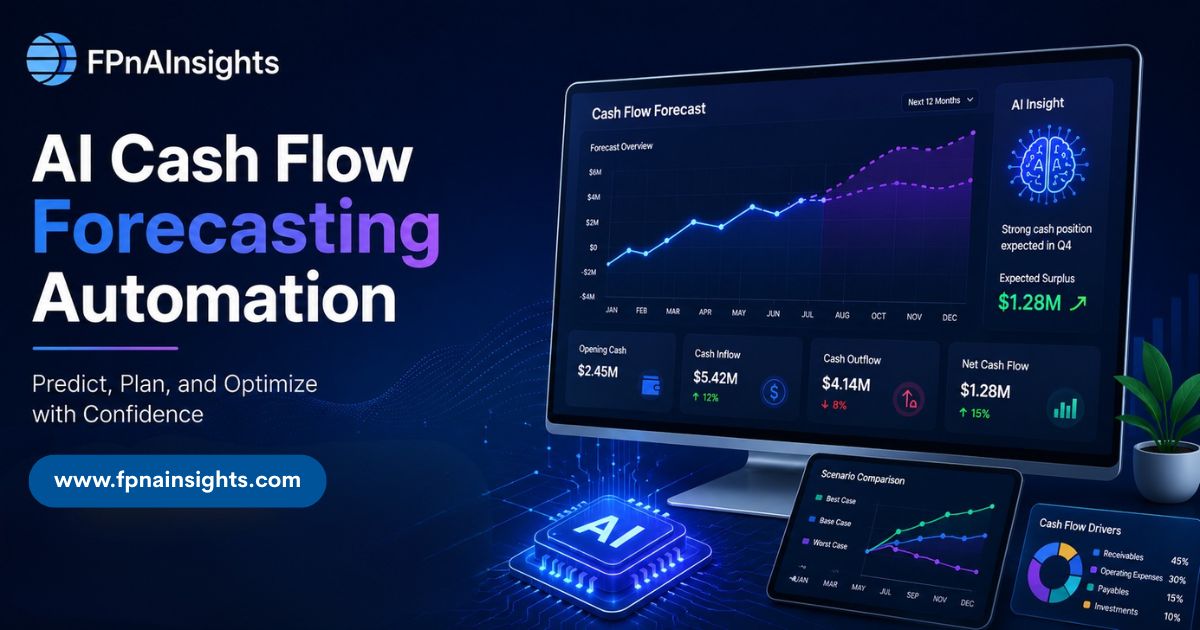
AI Cash Flow Forecasting Automation: Predict, Plan, and Optimize with Confidence
AI Cash flow forecasting automation applies machine learning and advanced data pipelines to produce, update, and test cash flow predictions on a continuous basis, replacing the traditional use of static spreadsheets with predictive financial insights.
For financial teams that have to navigate multi-entity environments, seasonality, or fast growth, uncertainty with regards to cash flow is a very tangible challenge. Failure to notice an open window for payment, a shortage of cash, or missing out on key financial decisions can narrow margins and shake stakeholder confidence. At FPnAInsights, we support our customers in transforming their approach to cash flow management with the power of automation.
Why Manual Forecasting Creates Structural Blind Spots
The traditional method of cash flow forecasting relies on analysts to compile information from disjointed systems, reconcile the numbers manually, and refresh the models periodically. Once the information becomes available for decision-making purposes, the data itself is outdated.
The issue isn’t about effort, but it’s about the design. Manual methods are unable to keep up with the speed of current finance data flows. Ageing receivables, vendor payment schedules, foreign currency rates, and other factors change more rapidly than a traditional model could account for. This inherent gap creates three potential threats: inaccurate forecasts of cash requirements in the near term, scenario models that rely on assumptions rather than reality, and finance departments that waste their valuable time collecting data instead of analyzing it. The answer is not doing things quicker in a flawed process, but it’s implementing AI Cash flow forecasting automation.
How AI Cash Flow Forecasting Automation Works in Practice
The AI Cash flow forecasting automation is directly linked with the company’s core systems, such as ERP software, treasury management systems, bank systems, and AR/AP applications, which provide real-time transactional data. Machine learning algorithms recognize patterns in the historical cash flow, then use that knowledge to forecast future cash flow with probability in both short-term and long-term scenarios.
The actual values diverge from forecast, and the system self-calibrates without any human input. In due course, as the system learns more about the interplay of payments, seasons, and economic cycles on cash flows, accuracy is enhanced.
The FPnAInsights' framework for forecasts is based on three levels of operations: real-time visibility of cash positions for all entities/accounts; rolling forecast automation for keeping 13-week and 12-month projections always up-to-date and financial scenario simulation for creating parallel paths of forecasts in stress situations – thus allowing finance organizations to test scenarios without being faced with an actual emergency.
Strategic Benefits: Accuracy, Scenario Planning, and Liquidity Control
There are measurable results of AI cash flow forecasting automation in three major categories important for CFOs and FP&A professionals.
Forecast precision increases as machine learning algorithms incorporate many more variables and the interactions between them compared to any manually generated model. Variables such as payment timings, customer concentration, receivable collection efficiencies, and intercompany transactions are incorporated into the forecast together.
Liquidity forecasting turns into a strategic tool instead of an accounting activity. Through rolling forecasts, financial professionals can spot liquidity shortfalls 30, 60, or 90 days down the road, well ahead of time for credit draws, collections acceleration, or discretionary spending deferral.
Scenario planning evolves from being an annual process into a continuous one. FPnAInsights provides tools for creating scenarios where finance can assess the impact of acquisitions, entry into new markets, or disruptions within supply chains in a matter of hours instead of days. Automation in planning improves governance with standardized scenarios, documented data lineage, and forecast history management.
Build Forecasting Confidence Through Intelligent Automation
The uncertainty associated with cash flow is not overcome by having a finance team work more diligently, but it is overcome by having a finance team work with superior tools, superior architecture, and superior modelling capabilities. With the implementation of AI cash flow forecasting automation, FPnAInsights works with finance executives to analyze forecasting maturity and determine how automation can help improve accuracy and provide greater control of liquidity and planning agility. If you are working with an existing process where you are reacting to cash positions and not forecasting them, then you need to consider automation options.
Q1. What is AI cash flow forecasting automation?
AI cash flow forecasting automation refers to the application of machine learning to create continuous cash flow forecasts. This involves replacing static models on spreadsheets with more active, up-to-date financial intelligence, thus allowing financial departments to transition from cash reactiveness to financial proactivity.
Q2. How does the automation of AI cash flow forecasting enhance the accuracy of the forecast?
AI cash flow forecasting automation enhances forecast accuracy because the process involves the simultaneous evaluation of several factors such as payment schedule, customer concentration, and intercompany flows. FPnAInsights uses machine learning algorithms which recalibrate themselves whenever there is any disparity between actuals and forecasts.
Q3. Why does manual cash flow forecasting become unreliable?
Manual forecasting leads to inherent blind spots because the information becomes outdated before it reaches management. Automation of AI cash flow forecasting ensures that real-time information is constantly flowing in through constant data ingestion. FPnAInsights assists finance professionals to get rid of spreadsheets and embrace perpetual forecasts.
Q4. How does AI automation contribute to scenario planning in cash flow forecasting?
Scenario planning through the process of AI cash flow forecasting becomes automated by moving the yearly process to an ongoing function throughout the year. FPnAInsights develops models that forecast the impacts of mergers and acquisitions, new market entry, and disruptions in the supply chain within hours to provide answers to important questions for finance executives.
Q5. Who gets the most benefit from using AI cash flow forecast automation?
The finance teams which operate multi-entity companies, those that deal with seasonal fluctuations, and fast-growing finance departments get the most out of this process automation. With the help of FPnAInsights, such teams can predict their financing needs within 30, 60, or 90 days in advance.
Shashi Konduru
Expert insights on FP&A, workforce planning, and business strategy transformation.