
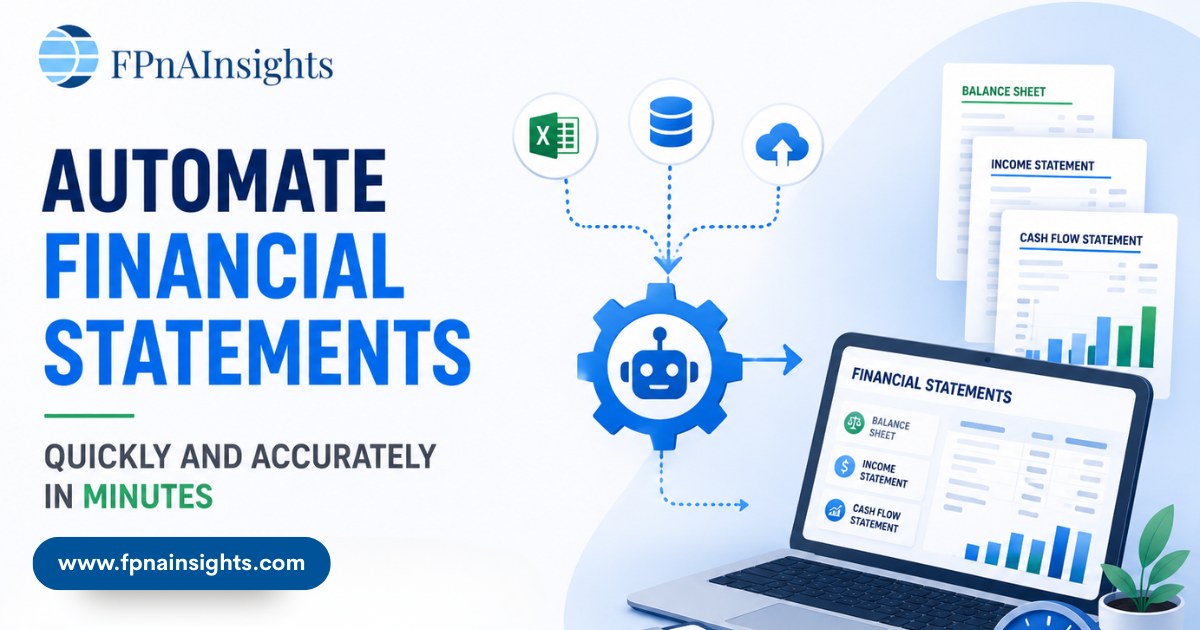
How to Automate Financial Statements Quickly and Accurately in Minutes
Finance teams lose hundreds of hours each quarter to manual data entry, formula errors, and last-minute scrambles before the books close. For CFOs and FP&A analysts managing complex, multi-entity organizations, that's not just inefficient, it's a liability. FPnAInsights helps finance teams eliminate that grunt work using powerful financial reporting automation tools, so your team can focus on strategy, not on spreadsheets. Here's exactly how to make the shift fast.
The Problem with Manual Financial Reporting
Manual financial reporting is slow, error-prone, and expensive to maintain. A single mis linked cell in Excel can cascade into a board-ready report that misrepresents margins by thousands of dollars. Mid-size companies often spend three to five days closing their books each month, time that analysts could spend on forecasting and scenario planning instead. Beyond accuracy, version control is a nightmare: multiple team members editing different spreadsheet copies creates reconciliation headaches that delay decisions at every level of the organization.
What Automation Actually Does
Modern financial reporting automation tools do far more than generate pretty charts. They consolidate data from disparate sources, your ERP, CRM, payroll platform, and general ledger, into a single, unified view. Real-time financial data flows into pre-built dashboards, so leadership always sees current numbers, not last week's exports.
At FPnAInsights, the automation engine is built to handle exactly this complexity. Automated finance reports can be set up to run on a daily, weekly, or end-of-month basis without any manual input required. All automated finance reports utilize the same logic and eliminate the possibility for human error. The effects: accelerated close periods, improved audit trails, and an FP&A staff focused more on analysis than assembly.
Step-by-Step: How to Automate Financial Statements in Minutes
Implementing financial reporting automation tools doesn't require a six-month IT project. Follow this practical sequence:
- Connect your data sources: Link your ERP and any cloud-based reporting systems to your automation platform via native integrations or APIs. This is your single source of truth.
- Select the right tool: Select finance automation tools based on your complexity; a small business with fifty employees is different from a large organization with twenty subsidiaries.
- Build or import report templates: Most platforms offer standard P&L, balance sheet, and cash flow templates. Customize them to match your chart of accounts and internal formatting standards.
- Schedule automated runs: Set reports to generate at defined intervals, daily flash reports, weekly variance summaries, or a full monthly close package.
- Review, validate, and distribute: Build an approval workflow so finance directors sign off before reports reach the C-suite or board.
Key capabilities to look for in any solution:
- Real-time financial data sync across all source systems
- Role-based access controls for sensitive data
- Drill-down functionality from summary to transaction level
- Financial reporting automation tools with audit trail logging
- Native integration with Excel or Google Sheets for analyst flexibility
Why FPnAInsights Is the Best Option
The FPnAInsights platform was created precisely for people working in finance who need speed as well as accuracy. While other BI platforms are general-purpose, FPnAInsights is designed to understand the intricacies of FP&A, multilanguage/multicurrency consolidation, intercompany elimination, and rolling forecast processes. It provides a full set of financial reporting automation tools that reduces the average closing period by up to 60%. Whether you're a regional CFO or running finance across global markets, the results speak for themselves.
Stop Closing the Books Manually
Automating your financial statements isn't a future initiative, it's a competitive advantage available right now. Teams that adopt financial reporting automation tools close faster, report more accurately, and free their analysts to drive real business value. The technology is proven, the implementation is straightforward, and the ROI is measurable within the first quarter.
Ready to transform your financial close process? Visit FPnAInsights today and see how automated financial reports can go live in days, not months.
Q1. What are the best financial reporting automation tools for mid-size companies?
The best financial reporting automation tools for mid-size companies consolidate ERP, CRM, and payroll data into real-time dashboards, eliminating manual errors and slow close cycles. FPnAInsights is purpose-built for exactly this need, offering scalable automation that fits growing finance teams without enterprise-level complexity or cost.
Q2. How can CFOs automate financial statements without a long IT implementation?
CFOs can automate financial statements in minutes by connecting data sources, selecting a proven platform, and scheduling reports. FPnAInsights makes this simple, its financial reporting automation tools require no lengthy IT project, with templates, integrations, and automated runs ready to deploy within days of onboarding.
Q3. How do financial reporting automation tools reduce errors in monthly close?
Financial reporting automation tools use consistent logic in all reports, thus ensuring no mistakes due to formula errors or versioning conflicts. FPnAInsights validates accuracy at every data transformation step, giving finance directors and global CFOs a reliable, audit-ready close package, every single month, without last-minute corrections.
Q4. Does automation software for financial reporting support multiple currencies and entities?
Absolutely, as some of the more sophisticated financial reporting automation applications can easily manage multiple currencies and entities through consolidation, elimination of intercompany items, and entity reporting. The FPnAInsights platform was created specifically for handling these kinds of complexities, offering financial data in real-time for all entities and currencies.
Q5. Why should finance teams choose FPnAInsights over generic BI platforms?
Unlike generic BI tools, FPnAInsights understands FP&A workflows, rolling forecasts, variance analysis, and scheduled report distribution. Its financial reporting automation tools cut average close time by up to 60%, giving finance teams across mid-size companies and global enterprises the speed, precision, and confidence they need every reporting cycle.
To Know more about FPnAInsights’ services, latest information, visit our Blog page
Shashi Konduru
Expert insights on FP&A, workforce planning, and business strategy transformation.