
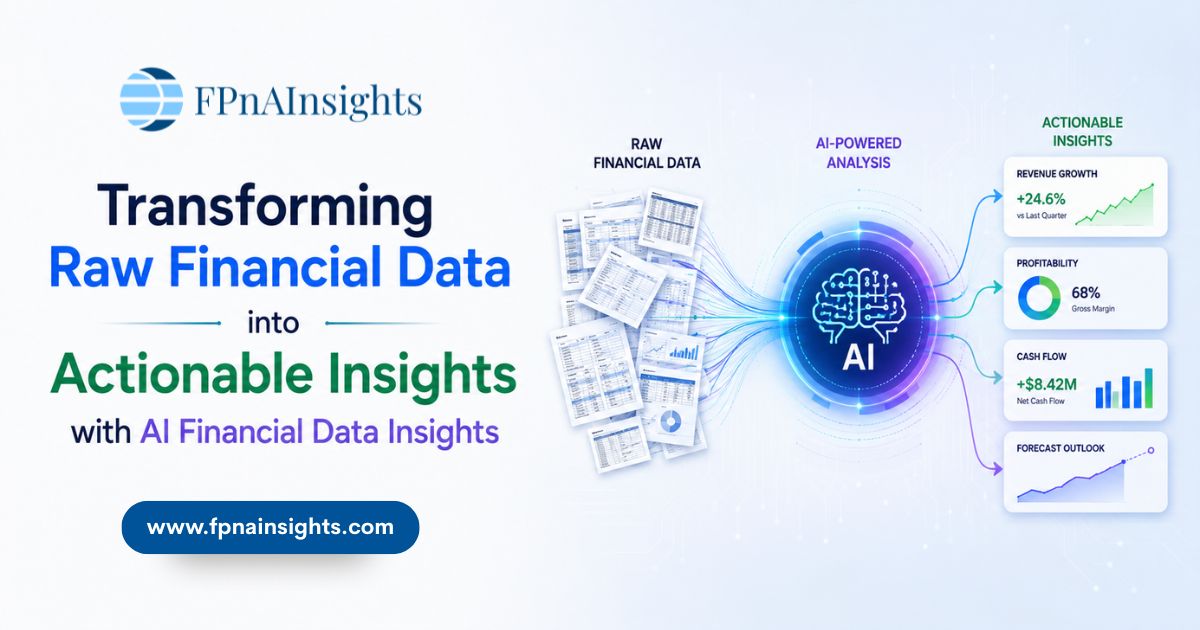
Transforming Raw Financial Data into Actionable Insights with AI Financial Data Insights
Finance departments are overwhelmed by information. The
number of spreadsheets increases, source systems become increasingly different,
and by the time that the report gets to the person who makes the decisions, the
numbers have already changed. AI financial
data insights turn that situation on its head by changing the role of
FP&A from one of reactive consolidation to proactive analytics. For
companies determined to bridge the information gap, FPnAInsights is that
solution.
What Exactly Is Financial Data Intelligence to an FP&A Team?
Financial data intelligence refers to the process of using
technologies such as machine learning and automation to manipulate raw
financial data in order to generate structured decision-oriented output.
This translates into:
·
Real-time
financial reporting that reflects actuals immediately upon posting, not after a
delay of 48 hours
·
Future-oriented
financial modeling that stress tests assumptions prior to becoming set in stone
·
Business
intelligence dashboards that detect anomalies and variances without the need
for further inquiry
Financial data intelligence transforms the role of the
FP&A analyst from data handler to strategist.
From Static Reporting to Dynamic Financial Performance Metrics
Conventional financial planning and analysis operates through
regular closes, whether monthly, quarterly, or annual. At each close, a
retrospective picture is produced for decision-making processes that have
already been launched. The result is a persistent lag between what the business
is doing and what finance understands about it.
AI financial data
insights disrupt
that cycle. By having access to ERP systems, general ledgers, and other
operational data sources, the modern platforms update their financial
performance metrics constantly without needing any manual exports or
reconciliations. Variance analysis that once consumed days of analyst time can
surface automatically, flagged, contextualized, and routed to the right
stakeholder.
FPnAInsights applies this approach through its
core intelligence layer, which monitors KPIs in motion rather than at rest.
Instead of building reports after the fact, finance teams operate with a
continuous view of where performance stands against plan, and why it's
diverging.
FP&A Automation That Supports Judgment, Not Just Speed
Automation in finance carries a reasonable concern, that it
reduces nuanced work to mechanical output. The more grounded argument is that
FP&A automation removes the mechanical parts, data gathering, format
normalization, version reconciliation, so analysts can focus on interpretation.
AI financial data
insights applied
within FPnAInsights follow that model.
Routine consolidations run on schedule. Rolling forecasts update as actuals
flow in. Scenario models refresh when input assumptions change. None of this
replaces the analyst's judgment about which scenarios matter or how board-ready
a narrative needs to be. It removes the friction that prevents that judgment
from being applied.
Enterprise financial analytics built this way tends to
produce faster cycles, tighter alignment between finance and business units,
and models that reflect current conditions rather than last month's close.
Data-Driven Decision-Making Requires Trustworthy Inputs
No amount of analytical sophistication helps if the
underlying data is inconsistent. A core discipline within AI financial data insights is data governance, ensuring that every
number has a traceable source, a defined calculation logic, and a consistent
definition across the organization.
FPnAInsights treats data integrity as a
foundation, not a feature. The platform's architecture connects source systems
through validated pipelines, so the figures appearing in a board dashboard
carry the same logic as those used in the detailed operating model. Finance
teams stop debating which version of a number is correct and start debating
what to do about it.
That shift, from data disputes to strategic dialogue, is the
practical outcome of well-applied AI
financial data insights at the enterprise level.
Conclusion
Turning raw financial data into decisions that hold up under
scrutiny requires more than reporting tools. It requires AI financial data insights built around FP&A workflows,
connected to live data, and governed well enough to be trusted at every level
of the organization.
FPnAInsights is built for exactly that purpose. To explore how the
platform supports financial planning and analysis teams in moving from data
volume to decision clarity, visit fpnainsights.com.
Q1. How can AI be used for financial data insights and what is the benefit to the FP&A team?
using AI financial
data insights and automation to transform financial inputs into output that
can be used in decision making. The service of FPnAInsights provides these benefits via live ERP connections and
KPI monitoring, which allows FP&A teams to move from reactive reports to
strategic analysis.
Q2. How does FP&A automation help reduce manual effort in financial planning processes?
FP&A automation takes away any manual efforts in the
process of data collection, data formatting, and reconciling versions. AI financial data insights help FPnAInsights automate routine
consolidations according to the schedule, rolling forecasts updates with
actuals posting, and scenario model updates.
Q3. What is financial data intelligence, and why is it significant for businesses?
Financial data intelligence refers to transforming input to
output with structure and decision-making through the use of ML and business
rules. FPnAInsights offers an AI financial data insights solution to
enterprises through trusted data pipeline processing, which makes sure that all
numbers displayed on the company’s dashboard have the same reasoning as its
business model.
Q4. How can businesses shift from their static financial statements to dynamic financial performance indicators?
The reporting cycles of companies are replaced by links to
their ERP and GL systems. The FPnA Insights module enables real-time updates on
the financial performance indicators without requiring any exporting. The
financial insights are automatically created via variance analysis by the AI,
and alerts are sent to the right people.
Q5. Which platform supports decision making via data with reliable financial data governance?
The FPnAInsights platform
is created to enable decisions with data for FP&A. The platform is built to
connect source systems with pipelines and provide AI financial data insights, ensuring that all numbers have an
accountable source and a standardized process of calculations. Finance teams,
therefore, get to discuss strategies and not data.
Shashi Konduru
Expert insights on FP&A, workforce planning, and business strategy transformation.