
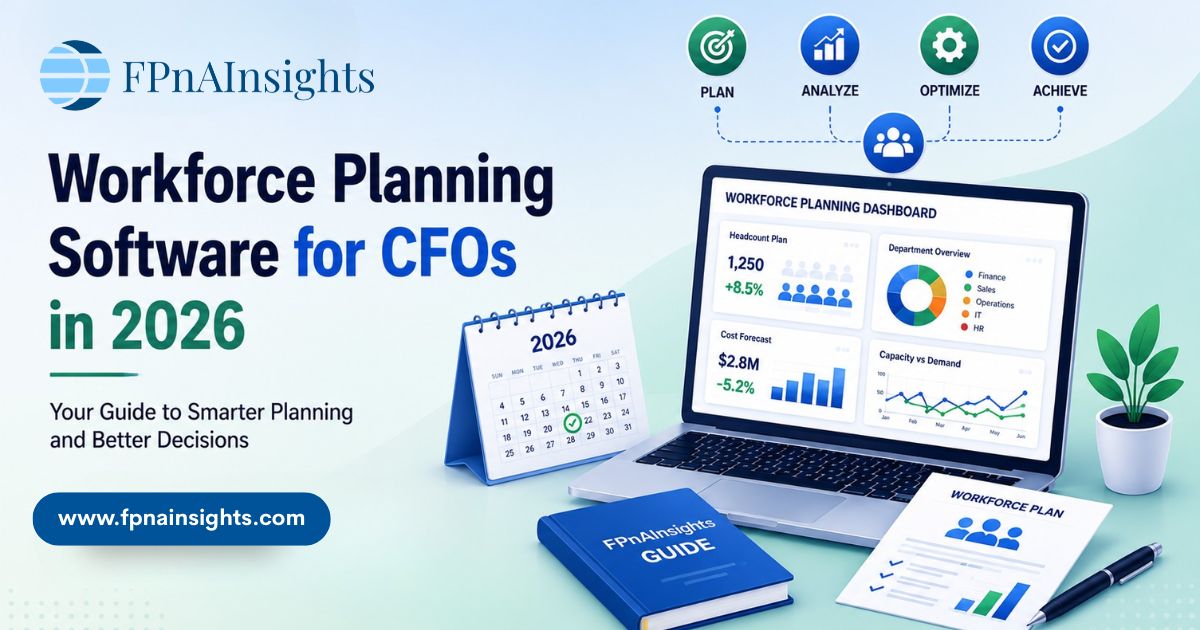
Best Workforce Planning Software for CFOs in 2026 | FPnAInsights Guide
Labour costs account for between 60-70% of overall expenses, but even today’s CFOs do not have access to real-time information about their headcounts, variance in scheduling, and risk of overtime until the end of the month. This creates significant opportunity loss. Workforce planning software converts this weakness into strength, giving CFOs precise control over their biggest expense item. As experts at FPnAInsights, we assist CFOs in cutting through the clutter and choosing software solutions that make financial sense.
Why CFOs Are Prioritizing Workforce Planning Software in 2026
The CFO position has evolved far beyond that of simply closing out accounts. The modern CFO is now expected to engage in strategic labour planning, analyze FTE scenarios dynamically, and remain compliant within an ever-changing regulatory landscape.
Legacy systems can’t keep pace, with modern workforce management solutions, CFOs have access to an integrated suite of labour spend analysis, headcount analysis, and schedule optimization tools, all in one application. The integration of HR technology with finance professionals is not just an advantage, it’s a necessity.
The FPnAInsights team continues to observe this trend among mid-market and enterprise finance departments: the companies that will triumph in 2026 are those that have been aligning their workforce forecasts with their financial plans since the very beginning.
What CFOs Should Look for in Workforce Management Software
Not all platforms are designed for the CFO’s perspective. In considering workforce management solutions, CFOs must focus on features that link workforce decisions with financial results.
The following is the list of essential features a CFO needs to look for:
- Workforce analytics in real-time with drill-down capabilities on the drivers of labour costs, departmentally, regionally, or functionally
- Salary management systems that automate payroll, minimize human error, and comply with local labour laws
- Headcount planning tools that are seamlessly linked to financial planning and analysis models and scenario planning processes
- Employee scheduling programs that optimize shift coverage while managing costs of overtime and benefits
- FTE management reports that compare planned vs. actual performance, highlighting variances
These functionalities turn raw workforce data into a powerful tool for proactive workforce planning.
Prediction for 2026: Artificial Intelligence (AI) and Finance-Human Resources Interaction
Artificial intelligence (AI) is shaping the development of workforce management solutions.
With today’s predictive analytics, organizations can use workforce forecasting models that account for attrition, seasonality, and shifts in market pay scales to help CFOs look forward rather than backward through the rearview mirror.
This year, the most important development in the area of finance and FP&A has been the fusion of HR and FP&A applications. Through combining HR planning software with financial planning tools using a single data platform, FP&A experts can model the complete costs of hiring additional staff, reorganizing company operations, and other similar actions within minutes rather than days.
This alignment can also enhance compliance. An automatic audit trail, labour law compliance, and payroll checks will reduce regulatory risks without any increase in the staffing in the finance department.
FPnAInsights Perspectives on Future Workforce Planning Trends for 2026
FPnAInsights sees a clear paradigm shift where CFOs have moved away from a reactive position when it comes to reporting the numbers to a proactive role in shaping the workforce strategy. Using AI-enabled workforce management software, the finance department can predict attrition risks, assess how labour costs might be affected depending on various scenarios for company growth, and align supply with demand.
Automation of the workforce is also redefining the finance officer’s relationship with HR leadership. The two disciplines are coming together with respect to a common data architecture, and those firms that establish this alignment in 2026 will hold a margin advantage through 2027 and beyond.
Make Your Workforce Data Work Harder
CFOs emerging as victors in 2026 are not merely focusing on cost control but have started leveraging Workforce planning software for strategic planning. Ranging from labour cost optimization to instant FTE tracking, the appropriate Workforce planning software platform helps in making people-based financial decisions.
FPnAInsights is your source for insights into evaluating finance-driven technologies, benchmarking workforce planning capabilities, and getting ahead of the tools that are impacting the CFO role.
Looking for the perfect fit for your organization? Join FPnAInsights to get expert insights, CFO modelling, and the future trends of workforce planning strategies in 2026.
Q 1: Which Workforce planning software is best for CFOs in 2026?
In 2026, the best Workforce planning software should have real-time workforce analytics, automated payroll calculation, and workforce planning functionalities. From FPnAInsights' perspective, the CFOs need a workforce management system that integrates FTE management and FP&A process flows, thus providing total visibility and forecasting of labour costs.
Q2: Which functionalities should CFOs seek in a good Workforce planning software?
The functionalities required by CFOs in a workforce management system include AI-driven workforce planning, payroll management, scheduling, and FTE dashboard functionalities. These functionalities are responsible for connecting the decisions made by the HR department to the financial statements of the organization. According to FPnAInsights, compliance monitoring and real-time analysis capabilities have been identified by finance leaders as essential functionalities required by 2026.
Q3: How can workforce management software assist in minimizing labor costs?
Workforce management software assists in minimizing labor costs by managing problems such as overtime, scheduling, and headcount. Scenario modeling allows quick actions to be made before problems become expensive. The top reason that is identified by FPnAInsights for the adoption of advanced workforce planning software by CFOs around the world in 2026 is optimizing labor costs.
Q4: How does AI influence workforce management software for CFOs in 2026?
AI influences workforce management software by making predictive headcount planning, predicting attrition rates, and performing compliance checks. Using AI, CFOs will be able to make decisions on headcount planning in an effective and efficient manner without doing too much work. According to FPnAInsights, the best practice for workforce planning in 2026 will be using AI technology.
Q 5: What is the Best Workforce Management Software for CFOs?
The Best Workforce planning software for CFOs incorporates headcount management, labour cost management, and payroll management into one single comprehensive financial grade software package. As stated by FPnAInsights, the most efficient Workforce Management Software includes real-time FTE tracking and simulation modelling, offering actionable labour intelligence directly to the hands of the decision-makers.
Shashi Konduru
Expert insights on FP&A, workforce planning, and business strategy transformation.