
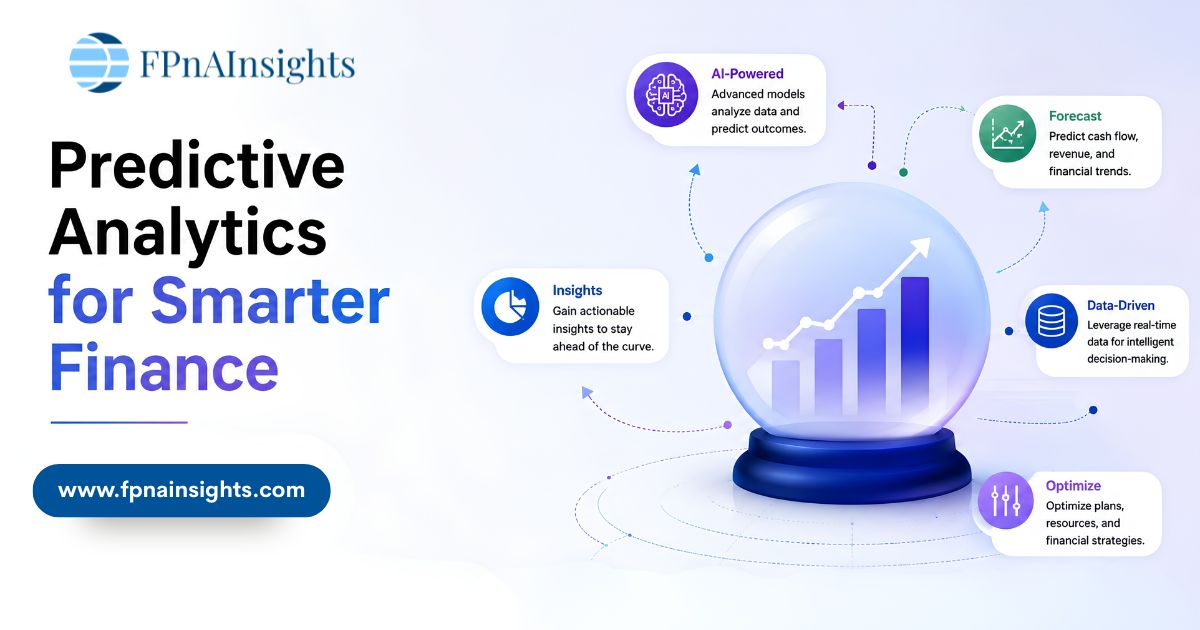
Predictive Analytics in Finance: Driving Data-Backed Decisions
The finance department has changed from a simple bookkeeper to being the driving force for businesses today. In today’s world, when firms are compelled to make faster and smarter decisions, the information is the key to competitive advantage. With FPnAInsights, firms can utilize their information advantage by way of predictive financial reporting, a unique method of ensuring that informed decisions are made even before the information becomes insufficient.
The Role of Predictive Analytics in Modern Finance
What is the exact definition of predictive analytics in the world of finance? In essence, this process entails utilizing statistical analysis, machine learning, and pattern recognition in the context of historical data in order to predict future financial performance instead of just recording past occurrences.
A traditional finance department operates in a reactionary mode. The finance team analyzes the numbers for the last quarter, compares the actual number against the projected number, and writes up a report based on that information. This predictive analytics process enables FP&A practitioners to anticipate future cash flow dynamics and risk management.
What is the outcome? Finance executives cease focusing on "What's gone wrong?" instead focus on "What's next?" – an approach which dramatically raises the importance of the finance function strategically.
How Predictive Financial Reporting Reshapes Decision-Making
In what way is predictive accounting distinct from traditional approaches? The difference resides in the capability to transform uncertainty into foresight.
While traditional accounting systems offer pre-determined reports on a monthly basis, predictive accounting enables one to forecast. Forecasting continues to be refined based on real data, market environment, and other financial factors. Budgeting becomes much more precise. Scenarios become faster and more reliable. The finance department can analyse the risk factors instantly, unlike yearly budgeting.
FPnAInsights addresses this challenge by offering analytics platforms that enable organizations to transition from spreadsheet-based reporting to intelligent modelling for decision-making. Under this framework, predictive financial reporting does not serve as a tool but rather a discipline that transforms the way finance professionals convey their message to management.
FPnAInsights recognizes that effective forecasting is limited by its underlying architecture, so we build capability into every insight we provide.
Key Capabilities That Make Predictive Models Effective
Predictive modelling involves far more than advanced algorithms. There are several basic skills that need to be integrated for optimal performance.
The machine learning skills allow models to discover the invisible patterns in large volumes of data that would never be discovered through traditional computations. Real-time pipeline skills help the forecast computations consider the latest events, like the number of exports yesterday.
In the variance analysis approach, which involves the comparison between actual and forecasted numbers, the model becomes more accurate in the long run since the approach assists in identifying areas that do not fit into the assumption. The rolling forecast, which is conducted on a monthly or quarterly basis, eliminates the rigid budgeting approach for the entire year and creates a flexible financing prediction approach.
Together, all these aspects form the basis of predictive financial reporting, giving the finance personnel the opportunity to make plans beforehand instead of planning retroactively.
A Strategic Shift
The greatest obstacle to the implementation of predictive analytics is not technological but, it is cultural. The financial executives must undertake a radical change in their style of analysis.
Being proactive entails creating models that will be able to forecast any dangers as well as growth potentials, presenting different scenarios to the board and not necessarily the results. With the use of predictive financial reporting, the above vision is made true for the financial executives because they earn respect in strategic discussions due to their analytical abilities.
Conclusion
Predictive analytics is changing the game for finance departments, transforming raw data into actionable insight and converting ambiguity into opportunity. Those companies that invest in predictive financial reporting now will be more adept at dealing with complexity, making wise investments, and staying ahead of competitors who continue to look back rather than forward.
The team behind FPnAInsights is passionate about helping finance professionals develop this ability through clarity, structure, and purpose. Are you ready to transition from reactionary reporting to strategic foresight? Discover more insights at FPnAInsights and learn how predictive analytics can revolutionize your financial decisions.
Q1. What is the applicability of machine learning in predictive financial reporting?
Using machine learning allows one to discover the patterns present within the huge dataset that may not easily be recognized through the use of normal mathematical equations. Machine learning always enhances its predictive ability by looking at its past input and mistakes within the historic dataset. FPnAInsights applies machine learning principles in its predictive analytics and accounting models.
Q2. How is predictive analytics useful in helping finance departments handle financial risks better?
Predictive analytics makes it possible to predict new financial risks before they occur through the analysis of their patterns, indicators, and trends together. This is an essential factor in favor of finance managers, since it gives them sufficient time to respond properly to changes in the situation. The FPnAInsights team uses predictive financial reporting methods to help organizations shift from being reactive to proactive about financial risks.
Q3. What is a rolling forecast and how does it compare to the annual budget?
The process of making rolling forecasts involves regularly updating the financial forecasts based on the latest information either every month or every quarter, unlike the annual budget, which is rigid. According to FPnAInsights, rolling forecasts form the central component of future-oriented financial reporting, helping financial teams adapt to changes within the business environment.
Q4. How does variance analysis enhance the predictability of financial reports in the long run?
Variance analysis is the comparison of actual outcomes to expected performance for purposes of pinpointing where assumptions made were erroneous. With each variance analysis, the more accurate the forecasting models can become. In FPnAInsights, variance analysis plays a key role in the process of predictive accounting by enabling finance departments to perfect their skills in forecasting while avoiding mistakes in future forecasts.
Q5. How will predictive financial reporting be helpful to small and medium-sized finance teams?
Predictive financial reporting is not something that belongs only to big firms. Small and medium finance departments can benefit just as much from switching from conventional manual and Excel-based processes to predictive financial forecasting techniques. FPnAInsights provides practical and systematic methods for using predictive financial reporting by small finance departments even if they don’t have big company infrastructure and full-time data scientists.
Shashi Konduru
Expert insights on FP&A, workforce planning, and business strategy transformation.