
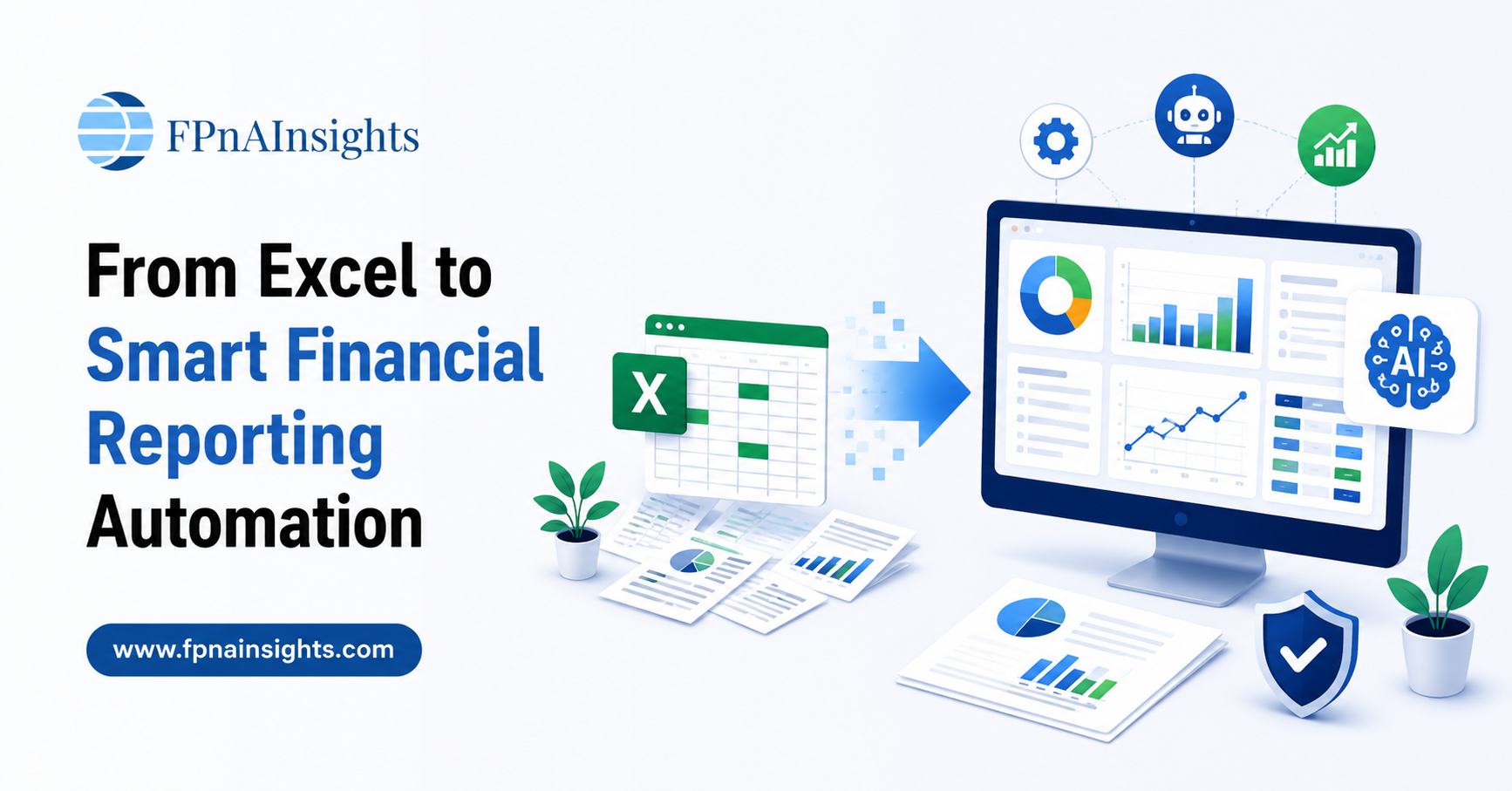
How Businesses Can Shift from Excel to Smart Financial Reporting Automation
The Excel Problem Nobody Wants to Admit
Roughly 90% of enterprise spreadsheets contain at least one material error, and finance teams are still building month-end closes around them. Excel was built for individual analysis, not collaborative, real-time financial reporting, yet most FP&A teams treat it as mission-critical infrastructure. The result: delayed closes, version-control chaos, and CFOs making strategic decisions from data that's already out of date. FPnAInsights has seen this pattern across organisations of every size, and the fix starts with understanding why financial reporting automation tools exist in the first place.
Three Pain Points Holding Finance Teams Back
Excel's limitations aren't abstract. They show up in three specific, recurring ways:
- Manual consolidation drags. With each business unit having its own workbook, the task of consolidation becomes a full-time job for the finance analysts who spend time on tab reconciliation instead of trend analysis.
- Fragile data accuracy. A single broken formula or mislinked cell can corrupt an entire model. In high-stakes reporting situations, that’s not an inconvenience in workflow; it’s an auditing and compliance problem.
- No real-time visibility. Excel is a static snapshot. By the time a file is distributed, the underlying data has moved. Leadership can't act on information that's already stale.
What Smart Financial Reporting Automation Actually Looks Like
Financial reporting automation tools are software platforms that connect directly to ERP and accounting systems, eliminating manual data entry and replacing static spreadsheets with live, governed data pipelines. These tools automate the repetitive work of financial close automation — journal entries, reconciliations, intercompany eliminations, while surfacing results through real-time dashboards that update as transactions post.
In practice, this means an FP&A team running a global close can see consolidated P&L in hours rather than days. Variance analysis that once required building pivot tables from scratch is generated automatically. Narrative commentary can be drafted from structured data, not assembled from memory.
At FPnAInsights, we work with finance teams navigating exactly this transition, helping them identify the right financial reporting automation tools for their data environment, ERP stack, and reporting cadence, without over-engineering the solution.
The Measurable Benefits for FP&A Teams
Organisations that complete a finance transformation away from Excel-centric workflows consistently report:
- Faster close cycles, often cut by 30–50%, freeing finance bandwidth for forward-looking analysis
- Improved data accuracy through single-source-of-truth architecture and automated reconciliations
- Richer FP&A reporting with live dashboards that non-finance stakeholders can self-serve
- Reduced audit risk from complete, traceable data lineage — no more mystery formulas
A Three-Step Framework for Making the Shift
Moving off Excel doesn't require a rip-and-replace approach. The teams that do it well follow a disciplined sequence:
- Audit your current reporting stack. Map every report, its data source, its frequency, and who owns it. You can't automate what you haven't documented. This step often surfaces redundant reports that can be retired immediately.
- Pain over passion. Choose the process that is taking you the most amount of time or has the most potential for errors, normally this is the monthly close or budget consolidation. Successes will breed confidence and commitment from leadership for larger-scale change.
- Select solutions that will play nice with your current technology. The ideal financial reporting automation tools work seamlessly with your ERP, SAP, Oracle, NetSuite, and so forth without necessitating the need for a parallel data environment. Evaluate vendors on data governance and audit trail capability, not just dashboard aesthetics.
The Path Forward
Finance teams that move beyond Excel don't just report faster but, they think differently. When the close runs on financial reporting automation tools and real-time dashboards replace weekly status meetings, FP&A becomes what it was always supposed to be: a strategic function, not a data-wrangling one.
If your team is ready to explore what that shift looks like, FPnAInsights publishes frameworks, implementation guides, and tool reviews built specifically for finance leaders making this move.
Q1. How do financial reporting automation systems work, and what are they?
They are software that connects directly to your ERP system (SAP, Oracle, NetSuite). Automation means no manual input, data reconciliation, and real-time dashbord reporting. FPnAInsights can help any company choose the most appropriate financial reporting automation tool depending on the existing ERP stack and required reporting cycle.
Q2. How has Excel become insufficient for financial reporting for companies with growing operations?
Excel brings the following three major problems to organizations: manual consolidation mistakes, broken formula chain, and delayed data being delivered to senior management. According to FPnAInsights, about 90% of all spreadsheets used in companies have material errors in them. Financial reporting automation tools provide the solution to these issues.
Q3. How long does it take to move from Excel to automated financial reporting?
Most finance teams see results within the first quarter using financial reporting automation tools, when they start with one high-pain process, typically the monthly close. FPnAInsights suggests a step-by-step approach with three steps: auditing, ranking based on the level of pain, and implementing solutions with native ERP integration.
Q4. What are the biggest benefits of financial reporting automation for FP&A teams?
FP&A teams adopting financial reporting automation tools report four consistent outcomes: close cycles cut by 30–50%, stronger data accuracy, self-serve real-time dashboards, and reduced audit risk through traceable data lineage. FPnAInsights emphasises the strategic shift this enables, finance moves from backward-looking data assembly to genuinely forward-looking business partnership.
Q5. How do I choose the right financial reporting automation tool for my business?
Evaluate financial reporting automation tools on three criteria: native ERP integration, data governance capability, and real analyst usability, never aesthetics alone. FPnAInsights publishes independent vendor comparisons assessed through a pure FP&A lens, covering close speed, audit integrity, and day-to-day analyst experience to help finance leaders make confident, informed decisions.
Shashi Konduru
Expert insights on FP&A, workforce planning, and business strategy transformation.